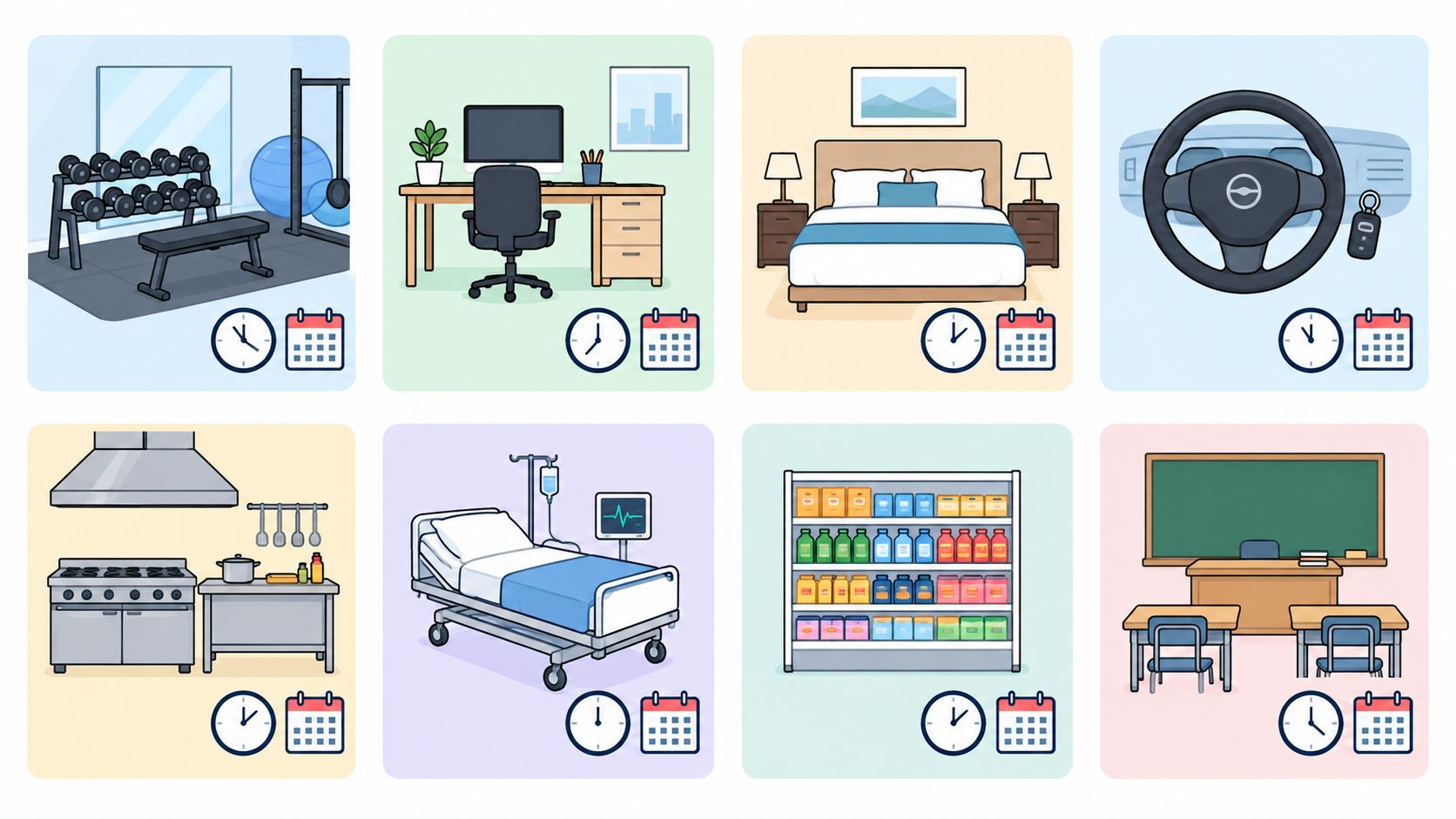
• Best Cleaning Schedule Ideas: 8 Facility Plans for 2026

    A busy gym floor at 6 p.m. tells you everything you need to know about a best cleaning schedule. Hands go from dumbbells to water fountains to locker handles in seconds, and the same pattern shows up in rental turnovers, dealership test drives, airport gates, and event venues. A fixed calendar misses that reality. A better rhythm follows traffic, touchpoints, visible soil, and the consequences of getting it wrong.

    That's why the strongest cleaning plans are built around use, not just time. The World Health Organization's risk-based guidance separates high-touch surfaces from low-touch ones and says cleaning should happen before disinfection when both steps are needed, while CDC guidance tightens frequency as occupancy and activity rise (WHO guidance, CDC disinfection recommendations). In practice, that means one facility may need hourly wipes at the front desk while another needs a steady daily rotation and a separate weekly deep clean.

    The eight plans below give you a structure you can use. Each one matches a real facility type, its busiest touchpoints, and the way staff move through the space. If you want a simpler buying decision while you build the routine, products such as disinfectant wipes for commercial use can help standardize the process across shifts and zones.

    1. Hourly High-Touch Sanitization Schedule for Fitness Centers

    A busy gym shows its cleaning standard in the moments people can see staff working the same high-contact surfaces over and over during peak hours. The CDC identifies free weights, exercise equipment, cardio machines, time clocks, locker room fixtures, vending machines, railings, door handles, countertops, toilets, light switches, phones, faucets, sinks, and keyboards as frequent-touch targets in athletic settings (CDC athletic facility guidance).

    Build the floor around repeat touchpoints

    Start with a full clean at opening, then run an hourly cycle on dumbbell handles, cable grips, machine touchpoints, locker handles, and water fountain buttons. Staff should clean shared equipment after each use and let it dry before the next person touches it, especially on surfaces that contact bare skin. Gym equipment wipes work well because staff can use them at the point of contact without slowing the floor.

    Practical rule: Put wipes where the hand already goes. If the station is easy to miss, the routine will fail.

    Boutique studios often handle this well by wiping bikes and rowers between classes and marking each station as cleaned. Yoga studios can do the same with yoga mat wipes at the entrance, so students can clean mats before class and again after use. A gym wipe dispenser near the front door helps keep the routine visible, and bulk gym wipes make sense for multi-location programs that need the same standard across shifts.

    A clean log near the front desk helps too. Zone ownership matters just as much. One staff member should never have to guess which row of equipment belongs to them.

    2. Airport Terminal Rolling Restroom and Gate Area Cleaning Cycle

    Airports move on banks of arrivals, delays, and rebookings. A restroom can go from acceptable to overloaded fast, and gate seating picks up new hands, bags, and spills as soon as the crowd shifts. CDC environmental-cleaning procedures support at least once-daily cleaning in waiting areas and more frequent service in busier spaces, and the EPA reminder on contact time still applies, the surface has to stay visibly wet long enough for the product label to do its job.

    Clean before the peak, not after the rush starts

    The strongest service window is just before a major arrival bank. That gives staff a clean slate before restrooms, kiosks, and gate seats fill up. Use EPA registered disinfecting wipes on kiosk screens, handrails, and restroom fixtures, and work from cleaner points to dirtier ones so contamination does not move across the terminal.

    The schedule only works if staff keep the surface wet for the full label contact time.

    That is where many airport routines fall apart. A quick wipe that dries too soon looks tidy, but it does not finish the job. Visible inspection rounds help too, because passengers notice posted restroom checks and other signs of active service.

    Terminal teams also benefit from a simple supply standard. One product line for counters, rails, and touchscreens keeps training and restocking easier, and commercial disinfecting wipes fit that kind of use well. For a practical look at why visibility matters to travelers, see why visible airport sanitation routines shape the traveler's first and last impression.

    3. Short-Term Rental Turnover Disinfection Schedule

    A guest walks into a rental and notices the details fast. Sticky switches, fingerprints on remotes, and any stale smell make the unit feel missed. Turnover work needs three phases, a quick high-touch disinfection, a full room reset, and a final inspection before the next arrival.

    Treat the turnover like a sequence, not a single clean

    Start with the items guests touch first. Remote controls, thermostats, light switches, door handles, faucets, and appliance panels should get disinfecting wipes on the first pass. Keep remote controls and light switches for the end of the room, so clean hands do not put soil back on fresh surfaces. A separate color-coded cloth or wipe for bathrooms and kitchens keeps the work cleaner and easier to track.

    Hosts who keep backup supplies in each unit avoid the scramble that happens when checkout runs long. Photo checklists and completion reports also help property managers confirm the reset before check-in. A visible, repeatable routine does more than a vague β€œcleaned” label.

    Use a checklist inside each unit. Guests and cleaners both need to see what was done, especially when turnover teams change.

    The sequence matters in practice. Replace wipes between rooms, not just between units, so contamination does not move from one guest stay to the next. A lot of hosts also build a restocking system around a short-term rental hygiene playbook for building guest trust between check-ins, because a visible reset makes the next arrival easier to trust. If you need a practical reference for that side of the job, see a short-term rental hygiene playbook for building guest trust between check-ins.

    4. Event Venue Pre-, During-, and Post-Event Cleaning Schedule

    Event venues run on spikes. The room can sit quiet for hours, then a crowd presses the restrooms, concession lines, entry points, and seating all at once. A workable venue schedule follows that pattern instead of trying to flatten it.

    Use three phases to stay ahead of the crowd

    Before doors open, crews should disinfect the guest touchpoints that will see the first wave of traffic. During the event, rotating teams should work restrooms, concession counters, and entry points on set rounds so buildup never gets ahead of staff. After the event, the building needs a full reset so the next booking starts clean.

    Guest self-service wipe stations help only when they are easy to spot and easy to reach. Place them at chokepoints where people naturally pause, such as entry lanes, concession queues, and restroom exits, and use clear signage so guests know when to use them. In food areas, a small supply of disinfectant wipes lets vendors wipe counters between orders without breaking the flow of service.

    Clean from top to bottom and from least soiled to most soiled. That keeps the crew from dragging residue into fresh areas.

    Stadium concourses usually need tighter restroom rotations during big games. Convention centers often pair event staff with overnight deep cleaning between multi-day bookings. The trade-off is simple. You need enough people to respond fast, but not so many in one zone that they slow each other down.

    The most common venue failure is an empty wipe station at the exact moment guests need it, so assign refill checks to a named role on every shift.

    5. Pool Club and Aquatic Deck Disinfection Schedule

    A pool club runs on two cleaning tracks at once. Water treatment keeps the pool safe, while the deck, loungers, locker rooms, showers, and fitness areas need their own surface routine. Humidity makes everything feel active, even during quiet hours.

    Separate water treatment from surface sanitation

    Clean decks and lounge chairs daily with approved products. Give locker room fixtures and handles more frequent attention, since they collect constant contact and moisture. Disinfecting wipes are useful for handles, locker keys, and shared accessories, but they do not replace pool chemistry or water testing.

    Use wipes for locker keys, handles, and lounge arms. Stainless ladder rails, diving boards, and deck drains need a dedicated degreaser and a weekly scrub, which wipes cannot deliver. Ventilate locker rooms during and after cleaning, because airflow matters as much as the wipe-down. A crew member cleaning in a closed, damp room is working harder than the checklist suggests.

    Check drains and grout lines every week so buildup does not turn into a larger hygiene problem. Private clubs often post locker room logs so members can see the routine in place, and hotel pool clubs often split deck care into morning and evening passes to match traffic. That split works because wet zones behave differently from dry ones.

    Keep the room ventilated, follow the label, and keep the water program separate from the surface program.

    6. Car Dealership Showroom and Test-Drive Vehicle Sanitization Schedule

    A dealership has a touchpoint problem. Sales desks, pens, tablets, coffee stations, steering wheels, touchscreens, door handles, and seat controls all get handled by many people in a short period. Test-drive vehicles are especially exposed because they move from one prospect to the next.

    Make every handoff look deliberate

    Test-drive vehicles should be wiped after each use. Focus on the steering wheel, gear selector, door handles, infotainment screen, and seat controls. Showroom surfaces should be cleaned several times a day, especially the desks and tablets people use while waiting for financing or appraisal details.

    Keep sanitizing wipes in every demo vehicle glovebox so the sales associate can clean the car as soon as it returns. That small habit changes the way the vehicle is perceived. It looks managed instead of rushed. Screen-safe wipes matter here too, because dealership staff need a clean finish without residue or haze on displays.

    Check manufacturer guidance before using any product on leather or perforated seats. The wrong wipe can create a different problem than the one you're trying to solve.

    A visible cleaning tag on the windshield helps the handoff feel credible. So does a checklist that records which vehicles were cleaned before delivery. In a showroom, the trade-off is speed against presentation. Sales staff want a quick turnaround, but customers notice when a car feels handled and not reset. A visible cleaning tag on the windshield plus a logged checklist per vehicle is what makes the handoff feel deliberate rather than rushed.

    7. Commercial Office Tiered Cleaning and Disinfection Schedule

    A busy office needs a schedule that follows how people use the space. Conference rooms that stay active all day need more attention than storage rooms or rarely used corners. The most workable office setup uses three tiers, daily touchpoint disinfection, weekly deep cleaning, and periodic restorative care for carpet and upholstery.

    Match the schedule to occupancy

    Daily work should focus on elevator buttons, door handles, copier panels, breakroom appliances, and conference room tables. If a surface gets touched all day, it should never wait for a weekly cycle; move it into the daily tier. In open-plan areas, commercial disinfecting wipes give staff a fast way to handle one touchpoint at a time without disrupting the rest of the room. Weekly work can cover dusting and deeper resets, while restorative care belongs on weekends or holidays.

    Occupancy matters too. Office buildings that use sensors or weekly occupancy checks can reduce cleaning on lightly used floors without wasting labor. The strongest schedules track which floors are occupied and send staff to where traffic is highest. That keeps the work tighter and easier to defend.

    Clean high-touch points before restrooms and breakrooms so staff don't carry contamination into the most sensitive spaces.

    Coworking spaces usually make the process visible, with wipe stations near shared desks and printers. Corporate campuses often push heavier restroom and breakroom service to overnight hours, when disruption is lower. The trade-off is simple. Faster work helps the day run smoothly, but dirty high-touch surfaces send the wrong signal quickly.

    For carpet and upholstery periodic care, see J.G. Carpet Cleaning LLC standards for medical-office cleaning frequency and method.

    8. Sports Arena and Stadium Locker Room and Seating Sanitization Schedule

    A sports arena creates three cleaning jobs at once. Locker rooms hold athlete contact and shared gear. Training rooms see repeated use of the same surfaces. Seating bowls and concourses need fast resets before and after each event. One generic schedule does not cover those patterns well.

    Separate athlete areas from guest areas

    Locker rooms and training rooms should be cleaned daily, with disinfection of benches, lockers, and shared equipment. Seating areas and concourses need cleaning before and after each event because the traffic pattern changes quickly on game day. Gym equipment wipes fit the athlete side of the building, especially at training tables, benches, and taping stations.

    Shared equipment needs tighter control between athletes or teams. Weights, medicine balls, and any surface touched during practice should be cleaned right after use. Taping tables and training-table surfaces need disinfection between every athlete, not just between teams, because skin-contact incidents spread fastest there.

    The guest side of the venue works differently. Armrests, cup holders, and other shared surfaces in the seating bowl need event-based cleaning, while larger areas often need broader tools than wipes alone. That split keeps the crew from treating every square foot the same way, and it avoids wasting time on low-risk surfaces while the building is still in motion.

    College athletic departments often post locker room logs for coaches and athletes, and pro teams usually disinfect shared tables after each practice. That visible routine matters because players and guests both judge the building by what they can see, so post the locker room log where both groups pass.

    Best Cleaning Schedules: 8-Point Comparison Guide

    Cleaning schedule πŸ”„ Implementation complexity Resource requirements πŸ“Š Expected outcomes ⭐ Key advantages and ideal use cases
    Hourly high-touch sanitization, fitness centers Moderate; hourly zones, full-floor cleans, and logs Peak-hour staff, wipes, dispensers, cleaning logs More consistent hygiene and visible cleaning activity Easy to train and audit; suited to gyms and studios with frequent equipment sharing
    Rolling restroom and gate-area cycle, airports High; zone coordination, fixed rounds, and on-demand response Large cleaning teams, digital logs, disinfectants, surge staffing Cleaner public areas and faster response to soiling Clear zone ownership and auditable rounds; suited to terminals with continuous, heavy traffic
    Turnover disinfection, short-term rentals Moderate; standardized checklist, photos, and inspection Turnover cleaners, wipes, restocking supplies, buffer time More consistent guest-ready properties and documented completion Supports review quality and cleaner onboarding; suited to rentals with frequent guest changes
    Pre-, during-, and post-event cleaning, event venues Moderate to high; three phases and attendance-based staffing Event crews, wipe stations, cleaning supplies, post-event teams Better upkeep during events and faster venue resets Clear phases simplify planning; suited to venues hosting large or back-to-back events
    Pool club and aquatic deck disinfection Moderate; separate surface and water-treatment protocols Trained staff, approved products, ventilation, water-testing supplies Cleaner shared areas and better control of buildup and slip hazards Distinguishes surface sanitation from water care; suited to pools, aquatic centers, and club facilities
    Showroom and test-drive vehicle sanitization, car dealerships Low to moderate; vehicle checklists and screen-safe product rules Wipes, screen-safe products, staff time, cleaning tags or logs More consistently cleaned vehicles and customer touchpoints Quick post-drive routine; suited to dealerships with frequent demos and loaner vehicles
    Tiered cleaning and disinfection, commercial offices Moderate; daily, weekly, and periodic tasks coordinated by occupancy Janitorial staff, shared wipe stations, cleaning logs, periodic-care supplies Consistent touchpoint cleaning with effort matched to use Helps manage labor and supply costs; suited to offices with variable occupancy
    Locker room and seating sanitization, sports arenas and stadiums High; separate schedules for game days, practices, and off-season Large crews, event-window staffing, wipes, mops, approved sprayers Cleaner shared athletic spaces and public seating Adapts cleaning to venue use; suited to facilities with athletes, crowds, and tight turnaround windows

    Start With One Schedule and Build Your Routine Around It

    The strongest best cleaning schedule isn't the one with the most tasks. It's the one that matches real traffic, high-touch points, and the way your team works. A fitness center needs repeat wipes on handles and equipment. An airport needs rolling restroom and gate-area service. A rental needs a disciplined turnover sequence. Each space has its own rhythm, and the schedule should follow that rhythm instead of forcing every zone into the same calendar.

    The practical move is simple. Pick the plan that looks most like your facility, then audit the busiest surfaces this week. Look at what gets touched first, what gets touched most often, and what gets missed when staff are rushed. Add disinfectant wipes where they reduce friction, and place supplies where staff can reach them without breaking the workflow. If you sell products, this is also where you can explain hygiene ROI in plain terms, because a visible routine helps customers see the value of consistent cleaning.

    Don't build the schedule once and forget it. Review it monthly, then adjust frequency when traffic, occupancy, or event volume changes. That keeps the routine honest and stops low-risk tasks from crowding out the surfaces that matter most. For more practical guidance on building a routine that sticks, see find a cleaning routine that sticks.

    If you're ready to tighten your own process, start with one zone, one log, and one reliable wipe product. Prioritize the surfaces people touch first, keep the wet contact time honest, and make the routine visible enough that your staff can follow it every day.
  • Short Term Rental USA: A Practical Sanitation Playbook

    Short term rentals in the U.S. are no longer a side business. By 2023, data tracked by AirDNA and summarized by the Congressional Research Service put the market at approximately 2.4 million short-term rentals generating an estimated $64 billion in annual revenue Congressional Research Service summary. With Airbnb the largest U.S. platform by listings and Vrbo behind it, cleanliness stopped being a housekeeping detail and became part of the revenue model.

    For operators, that shift matters because guests now judge the stay, the neighborhood, and the host's professionalism through the condition of the room. When a guest sees a clean, documented turnover, the listing feels safer and more reliable. When they don't, reviews turn into a bill collector.

    An infographic showing statistics on how cleanliness impacts short-term rental businesses and guest satisfaction levels.

    Why Short Term Rental USA Operators Are Rethinking Cleanliness

    A lot of hosts still treat cleaning like a final walk-through. That is too narrow for a market this visible. The Congressional Research Service summary notes that active supply averaged about 1.5 million properties at any given time because of seasonality and owner use Congressional Research Service summary. In a category that crowded, one weak turnover can drag down trust faster than a vacancy can be filled.

    Cleanliness now sits inside the revenue story

    During the recovery from COVID disruption, short-term rentals took a larger share of accommodation demand. AirDNA data reported by S&P Global Market Intelligence showed that STRs accounted for 13.3% of U.S. accommodation demand in June 2022, up from 9.7% in December 2018 S&P Global Market Intelligence. That shift changes the cost of a missed detail.

    A cleaner unit does more than avoid complaints. It signals that the host is organized, responsive, and worth the rate. I manage units across different jurisdictions, and the pattern is consistent: the property that arrives crisp and documented has a better chance of holding rate, while the one that arrives rushed usually spends the stay defending itself.

    Treat the turnover as part of the sales process. The reset the guest walks into is the first product photo they experience in person.

    Practical rule: if a guest can see that the turnover was managed well, they are more likely to forgive a minor issue later. If they see dust, fingerprints, or a stale smell on arrival, the stay starts uphill.

    Why documented sanitation beats casual reassurance

    Guest-facing evidence matters because disputes happen. If a guest says the place was not cleaned properly, you need more than memory or a cleaner's word. A timestamped checklist, a few inspection photos, and a clear sanitation routine make it easier to defend the stay, talk to the platform, or explain the process to an insurer.

    The business case is straightforward. Cleanliness protects review scores, and it also protects the property manager's time. Fewer disputes mean fewer refunds, fewer repeated clean-outs, and less back-and-forth with guests who already feel disappointed.

    The Patchwork of U.S. Short-Term Rental Rules

    U.S. short-term rental operators work inside layered rules that rarely line up. City permits, state tax registration, HOA restrictions, and property-specific limits can all apply at once, and each one affects how a unit is turned, documented, and kept guest-ready. In that kind of fragmented system, sanitation records are not just for guest satisfaction, they also show that the operation is controlled and consistent.

    An infographic showing the hierarchical levels of U.S. short-term rental rules from federal to property-specific levels.

    One city can change the economics of a listing

    A peer-reviewed study of San Francisco's registration requirement found that regulation reduced Airbnb availability by 20% to 27% and booked nights by 22% to 31%, while increasing booking prices by 3.3% relative to comparable listings in surrounding untreated cities. The same study estimated about 27,182 fewer booked nights per month and a $5 million monthly reduction in host revenue peer-reviewed study. For operators, that is the trade-off, compliance is not paper-shuffling, it changes revenue, pricing power, and how much mistake room you have.

    The practical response is simple. Verify permit eligibility before acquisition, then track renewal dates and keep occupancy and safety records from day one. I have seen owners buy furniture first and read the local rules later, only to learn the property cannot legally run the way they planned. That gets expensive fast, especially when a city enforces registration through platform removal.

    Where different operator types get hit

    City hosts have to watch permit status, occupancy caps, and host-presence rules. Vacation-market managers usually have to track local licensing, tax collection, and HOA standards. Small-town owners may feel less pressure at the start, but one restrictive zoning change can still reshape the math overnight.

    The Fresno short-term rental rules page from Edinhart Realty and Property Management shows what a city-level file should contain. It lays out permit types, occupancy caps, renewal steps, and other local requirements in one place, which makes it a useful template for building your own market file.

    Keep one compliance folder for each property. If the city, platform, or guest raises a question, the answer should be in one place, not buried in texts or scattered across emails.

    How Disinfecting Wipes Work on Rental Surfaces

    A disinfectant wipe works only when the surface remains visibly wet for the product's full contact time. Wiping away the moisture immediately turns disinfection into surface cleaning. If a counter, handle, or fixture has heavy soil, clean it with a separate wipe first, then apply the disinfectant.

    An infographic showing four steps to properly use disinfecting wipes on surfaces for short-term rental cleaning.

    Use the wipe as a contact-time tool

    I explain the process to cleaners the same way I explain locker-room sanitation to gym staff. The pass across the surface matters less than keeping it wet long enough to work. Follow the product label, because contact times vary. One EPA label example specifies a one-minute contact time, with the surface kept wet before air-drying EPA label example.

    That makes EPA registered disinfecting wipes useful for short-term rentals, offices, schools, and gyms. The label defines where and how the product may be used. A polished surface can look clean, while correct contact time provides a more defensible risk-control process.

    For fitness-focused rentals, stocking a wipe station for shared workout gear is a guest-facing hygiene signal guests notice immediately. It also gives cleaners a clear tool for handling equipment between stays without turning the amenity area into a vague cleaning task.

    High-touch surfaces worth your attention

    Prioritize surfaces that receive repeated hand contact:

    • Door handles and locks can retain grime even when the rest of the entry looks clean.
    • Light switches and remotes show fingerprints quickly and are easy to miss during a rushed turnover.
    • Thermostats and kitchen pulls need a deliberate pass because they are touched throughout a stay.
    • Bathroom fixtures and hairdryer handles often look clean while still receiving frequent contact.
    • Shared amenities need the same attention when a property includes workout equipment or patio gear.

    A documented focus on these points helps connect sanitation work to guest confidence and operational risk. In a fragmented U.S. short-term rental market, that consistency can support stronger reviews without relying on a generic cleanliness claim.

    The internal guide on contact time for disinfectants provides a useful refresher for product use. If you stock sanitizing wipes or disinfecting wipes, label them clearly and train cleaners on which surfaces must stay wet and which should be wiped dry.

    A Turnover Protocol That Holds Up to Inspection

    A turnover only becomes defensible when it leaves evidence behind. That's the standard I use across mixed jurisdictions, because a guest complaint, a platform review, or a property dispute can land on your desk long after the cleaner has left. A clean-looking room is helpful. A clean room with timestamps, photos, and signed checkpoints is stronger.

    A professional housekeeper holding a checklist and pen in a clean, modern kitchen of a rental home.

    Build the turnover around proof

    Start with a pre-arrival walk-through. Check the obvious failures first, things like trash, odors, leftover personal items, and missed linens. Then move into low-touch cosmetic work, because you don't want to disinfect a greasy counter and then re-touch it during the rest of the clean.

    After that, finish with high-touch disinfection and take photo-stamped inspection points. I want one image of the kitchen touch surfaces, one of the bathroom touch surfaces, one of the entry hardware, and one of any shared amenity area. That's enough to show a pattern without slowing the team down.

    If the property has a shared patio, hot tub area, or fitness room, treat it more like a hotel recovery zone than a private house. The same idea behind commercial disinfecting wipes in gyms applies here, especially for handles, switches, and control panels. In larger amenity spaces, a gym wipe dispenser or a stock of bulk gym wipes can make the process faster and more visible to guests.

    For a cleaner-friendly template, I also keep a copy of the short-term rental cleaning checklist in the property folder.

    Make the cleaner's sign-off useful

    A checklist that only says β€œdone” doesn't help much. Use items that can be verified:

    • Entry hardware wiped and photographed: confirms the first contact point is handled.
    • Kitchen touch surfaces disinfected last: reduces recontamination.
    • Bathroom controls and fixtures checked: catches the spots guests remember.
    • Amenity wipe station restocked: signals visible hygiene support.
    • Final sign-off time recorded: shows when the unit was ready.

    For a broader turnover framework, turnover tips from Rubber Ducky are a useful reference point for sequencing, even if you adapt the steps to your own properties. I also use that same structure when training newer cleaners who need less theory and more repeatable steps.

    From Clean Rooms to Higher ADR and Better Reviews

    Cleanliness is one of the fastest ways to lose a good review and one of the cheapest ways to protect a rate. Industry reporting shows that 45% of travelers with a disappointing vacation-rental stay blamed cleanliness, and 33% listed inadequate cleanliness among their top five complaints industry compilation. That's not a tiny preference, it's one of the main reasons guests are unhappy.

    The pricing side matters too. In August 2025, available listings reached about 1.79 million, occupancy averaged 58.6%, ADR rose 4.7% to $332.46, and RevPAR increased 3.6% to $194.87 Discover Kalispell monthly research update. That mix says pricing power can still offset softer occupancy, but only if the listing earns enough trust to command the better rate.

    Sanitation turns into pricing leverage

    When supply is heavy, a listing with cleaner photos, consistent inspection notes, and fewer complaint patterns can defend a stronger ADR. Guests will pay more for a stay that looks professionally managed. They're less forgiving when a host presents a premium rate and then hands over a rushed turnover.

    Here's the table I use internally when I'm reviewing feedback trends.

    Sanitation Signal What It Replaces Why It Matters
    Photo of wiped high-touch points β€œWe cleaned it” Gives guests visible proof
    Timestamped turnover log Memory-based reassurance Helps with disputes and platform questions
    Restocked wipes station Hidden hygiene effort Shows active care during the stay
    Weighted inspection score General cleanliness rating Makes sanitation measurable over time

    The point isn't to become obsessive. It's to stop guessing about what guests notice. When you tie sanitation defects to review score drops, refund requests, and repeat-booking patterns, the ROI becomes visible inside your own PMS or spreadsheet.

    Seasonal Protocols That Scale With Risk

    Baseline turnover work stays constant. Seasonal risk work should change with the calendar. Summer, allergy season, winter, and flu season all create different sanitation priorities, and the best operators adjust without overcomplicating the process.

    Match the protocol to the season

    In peak summer, faster turnover cadence matters more because more guests mean more touchpoints, more trash, and more opportunities for missed contact surfaces. In allergy season, I spend more time on vents, fabrics, and visible dust because guest complaints often read like cleaning complaints even when they start as comfort complaints. In winter, freeze-risk prep matters around pipes, hot tubs, and outdoor amenities, where a missed step can become a repair ticket.

    For STR fitness corners, the same sanitation logic used in sports facilities applies. A 2021 study of sports-fitness centers found bacterial contamination on bicycle handles, dumbbells, and sit-up benches, with loads ranging from 390 to 3,720 CFU/cmΒ² and E. coli levels from 550 to 1,080 CFU/cmΒ² sports-fitness center study. If your rental has shared workout gear, fitness wipes, workout wipes, and a plan for gym equipment cleaning wipes aren't optional extras, they're part of the turnover logic.

    Keep the seasonal calendar simple

    A practical calendar can live in the PMS, a Google Sheet, or the ops binder. I keep it simple enough that a cleaner can follow it without interpretation.

    • Summer: reinforce trash removal, odor control, and outdoor touch surfaces.
    • Allergy season: increase dusting attention and check soft furnishings.
    • Winter: protect water lines, outdoor furniture, and amenity storage.
    • Flu season: raise the priority on visible high-touch disinfection and restocking.

    Routine disinfection can reduce contamination without eliminating it completely, which is exactly why the schedule matters. In a gym study across six facilities, total bacterial load fell from 3,800 to 1,360 CFU per 100 cmΒ² after disinfection, a 64.2% reduction Frontiers in Public Health. The lesson transfers cleanly to shared rental amenities, use a layered program, not a one-time wipe-down.

    Debunking the β€œCleaner Is Always Better” Selling Point

    Guests judge cleanliness through smell, touch, and visible order. Heavy chemical fragrance can suggest masking, while excessive product displays make a rental feel institutional. Cosmetic perfection also has limited value when handles, switches, remotes, and appliance controls receive less attention than floors or decorative surfaces.

    Prioritize risk reduction over cosmetic excess

    The strongest cleaning programs put high-touch disinfection first and use lighter cosmetic work to finish the room. Neutral air, dry surfaces, and consistently treated contact points create more confidence than a room saturated with fragrance. In my operations, guest-facing hygiene signals build more trust than unopened supplies hidden under a sink.

    Keep the wipe station from your turnover protocol visible where guests use shared amenities. A clear location near exercise or wellness equipment shows that hygiene is part of the stay and lets guests handle a surface themselves without contacting the host.

    The goal is a room that feels cared for, with the evidence concentrated where hands land.

    Use evidence to separate friction from failure

    Inspection photos, weighted sanitation scores, and refund patterns show whether a complaint reflects a missed step, an unsuitable product, or a weak workflow. Repeated complaints at one property point toward a protocol or supervision problem. Complaints tied to one touch zone call for tighter targeting. Persistent odor or residue, even in an orderly room, indicates that the product mix, application method, or ventilation deserves review.

    Documented checks also make regional operations easier to manage. A cleaner can show which areas were completed, a supervisor can compare scores across properties, and an owner can see the work behind the guest experience. That record supports faster corrections when enforcement or review pressure rises.

    A layered program still needs user-facing access, scheduled staff disinfection, and documentation. Keep those elements connected to the same checklist, so guest convenience does not replace professional turnover work and professional work does not disappear from the operating record.

    Your 30-Day Sanitation Upgrade for Short Term Rental USA Hosts

    Start with a sanitation file for every property. Add the turnover checklist, a photo protocol, a weighted inspection score, and a seasonal calendar. Then standardize the wipe products you'll stock, including disinfectant wipes and, where relevant, fitness center wipes or gym equipment wipes for amenity areas.

    For a practical next step, use wipes.com as one option for stocking bulk gym wipes, commercial disinfecting wipes, and dispenser-friendly products that fit STR amenity kits. The goal isn't to buy more stuff, it's to make sanitation visible, repeatable, and easy to audit.

    If you manage short-term rentals in the U.S., treat cleanliness as a revenue and risk-control system, not a generic chore. The operators who document it will usually be the ones who defend reviews, hold rate, and survive tighter enforcement with fewer surprises.

  • Cleaning Wipes vs Disinfecting Wipes: Key Differences

    Most wipe programs fail before anyone chooses the wrong product. The usual advice says cleaning wipes remove dirt and disinfecting wipes kill germs, then recommends switching to the second option. That advice is incomplete. A disinfecting wipe only delivers disinfection when the treated surface stays visibly wet for the complete label contact time. If the wipe dries during the pass, the routine may look thorough while failing to meet the product's claim.

    That makes cleaning wipes vs disinfecting wipes an operational decision, not a simple shopping decision. Managers need to assess soil, active chemistry, EPA labeling, wet-contact time, surface compatibility, facility use, and labor. The same logic applies whether you manage a gym, airport, office, dealership, restaurant, school, or retail store.

    Why Most Wipe Programs Quietly Overpromise

    A tub marked β€œdisinfectant” does not disinfect a surface on its own. The user must apply enough solution, cover the entire target, keep it visibly wet for the label's contact time, and let it air-dry when required. A quick swipe followed by immediate movement to the next machine often delivers cleaning, not disinfection.

    The β€œone wipe per surface” rule breaks down on large benches, treadmill rails, shared desks, and electronic controls. One wipe can spread solution widely while leaving too little moisture for the required dwell time. CDC guidance notes that early-care and education settings may need more than one disinfecting wipe to keep electronics wet for the stated contact time. CDC guidance on cleaning and disinfecting early-care settings reinforces the operational point: coverage and wetness determine performance.

    The labor impact is easy to miss. A 75-count tub that dries in 90 seconds on a treadmill rail may require 2-3 wipes per machine, while a wipe that stays wet for 3 minutes may complete the same task with one. The cheaper tub can therefore create higher usage and labor costs. Sales demonstrations should measure full-surface coverage and label compliance, not just how quickly staff can wipe.

    Customers need a routine that addresses visible soil, wet contact, and consistent coverage across high-touch areas. A product can look effective while staff use too little solution or leave the surface dry too soon.

    A useful facility review checks:

    • Definition: What does the wipe do?
    • Active chemistry: Which ingredients support the claim?
    • EPA labeling: Does the intended pathogen and surface appear on the label?
    • Wet-contact time: How long must the surface remain wet?
    • Facility fit: Where will staff or customers use the product?
    • Decision flow: Is cleaning, disinfection, or both required?
    • Operational checklist: How will teams stock, deploy, and verify the program?

    Visible residue, grime, or uneven coverage damages customer trust when staff appear to clean equipment. A documented routine protects that trust better than a prominent canister without training. Facilities can also use this brand reputation protection guidance to connect sanitation practices with the wider customer experience.

    Cleaning Wipes and Disinfecting Wipes Defined

    Cleaning and disinfection use different mechanisms, even though both may involve the same wipe format. Cleaning wipes physically remove dirt, organic matter, and germs through wiping action. They improve visible cleanliness, but they don't necessarily kill the microorganisms left behind. Disinfecting wipes use chemical agents to destroy many or most harmful microorganisms remaining after cleaning. The Centers for Disease Control and Prevention identifies cleaning as the necessary first step because dirt and organic material can interfere with disinfectant performance. CDC cleaning and disinfection definitions provide the governing distinction.

    Sanitizing sits between the two concepts. Sanitizing reduces germs to levels considered safe by public-health standards, while disinfecting uses stronger chemical action to kill remaining germs. A product's label determines what claim it can make. A wipe doesn't become a disinfectant merely because it removes soil or includes an antibacterial marketing phrase.

    An infographic comparing the functions, uses, ingredients, and differences between cleaning wipes and disinfecting wipes.

    A wipe cannot be called disinfecting simply because it has an antibacterial claim. The product needs an applicable regulatory claim and must be used according to its label.

    For facility teams, the distinction is straightforward:

    • Cleaning wipes: Use for fingerprints, dust, sweat, food residue, and general soil when pathogen reduction isn't the primary objective.
    • Disinfecting wipes: Use when reducing viable pathogens on a compatible surface is the operational objective.
    • Sanitizing wipes: Use when the product's label and facility procedure call for reducing germs to an accepted public-health level.

    The format doesn't decide the function. A pre-moistened cloth may clean, sanitize, or disinfect depending on its formulation and approved claim. Managers comparing products should therefore review directions rather than rely on packaging language. A practical resource on how to compare all purpose cleaners and disinfectants can help teams separate routine soil removal from antimicrobial treatment.

    Active Ingredients and EPA Registered Performance

    Chemistry sets the claim a disinfecting wipe can make, but it does not guarantee the same result on every surface. Commercial products commonly use accelerated hydrogen peroxide, alcohol-based formulations, or quaternary ammonium compounds. These families differ in material compatibility, evaporation, residue, and the wet time needed for the label claim.

    An EPA registered disinfecting wipe must stay within its label. Check the listed organisms, approved surface types, directions, and contact time before assigning it to a station. Registration applies to a defined product claim, not every surface, pathogen, or application method. Staff should also follow workplace handling procedures and review suitable chemical safety information. Facilities seeking broader background can find pest treatment chemical info, but the individual wipe label remains the operating authority.

    Disinfecting wipe chemistry at a glance

    Active ingredient family Typical contact time Strengths Watch-outs
    Accelerated hydrogen peroxide Varies by product label Can support broad surface disinfection and may leave limited residual chemistry after drying Verify material compatibility, target organisms, and the full wet-time requirement
    Alcohol-based formulations Varies by product label Fast evaporation and useful compatibility for some hard, nonporous surfaces Rapid drying can make the required wet period difficult to maintain
    Quaternary ammonium compounds Varies by product label Common commercial disinfectant chemistry with established label applications Check residue, surface restrictions, and whether rinsing is required for the intended use

    A peer-reviewed keyboard study shows why facilities should not treat products as interchangeable. On computer keyboards, the tested wipes produced mean reductions in colony-forming units of 91.5% for an accelerated hydrogen-peroxide formulation, 65.3% for an alcohol formulation, 94.9% for a quaternary-ammonium-compound formulation, and 78.8% for a non-typed formulation group.

    The practical takeaway is product-specific performance. Surface material, target organism, soil level, application volume, and wet contact time all affect the outcome. Record those variables before selecting wipes for shared electronics, machines, counters, mats, or door hardware. A wipe that dries before the label time is complete has not delivered the claimed disinfection, regardless of its active ingredient.

    Fitness equipment requires a separate compatibility check. For wipes to disinfect gym equipment, confirm that the label permits the equipment material and supports repeated use. Yoga mat wipes may require different compatibility decisions from stainless-steel handles or coated screens. Do not assume a product approved for hard, nonporous equipment also suits skin-contact surfaces, porous mats, or food-contact areas.

    Before adding a product to a commercial supply program, review EPA registration number considerations. The registration number, label directions, and station workflow should agree. If staff cannot keep the surface wet for the required time, choose a different product or change the dispensing and labor process.

    Contact Time Coverage and Pre-Clean Rules

    The label is the procedure. EPA directions require users to apply enough product to keep the treated surface visibly wet for the stated contact time, then allow it to air-dry where directed. If the surface dries early, add product according to the label. Don't call the task complete because the wipe touched every part of the surface.

    Use a simple floor-level routine:

    1. Inspect the surface. Look for grease, sweat buildup, food residue, dust, or bodily fluids.
    2. Clean visible soil first. Use a cleaning wipe or another approved cleaning method when grime is present.
    3. Apply disinfectant generously. Cover the complete target surface, including edges and frequently handled controls.
    4. Watch the wet period. Keep the surface visibly wet for the label's stated contact time.
    5. Let it dry or rinse as directed. Food-contact surfaces and other restricted applications may have additional label instructions.

    Heavily soiled surfaces may need a separate cleaning step before disinfection. A disinfecting wipe shouldn't be forced to absorb grease and perform pathogen control at the same time. That approach consumes product while reducing the likelihood that the disinfectant reaches the surface evenly.

    An infographic showing a five-step cleaning process and pre-clean rules for achieving the best surface cleaning results.

    Size the job around the surface

    A single wipe may be enough for a small phone or door handle if it maintains the required wetness. It may not be enough for a bench, treadmill console, large shared laptop, or elliptical frame. Staff should test representative surfaces with a timer, observe how quickly the product dries, and record how many wipes are required for compliant coverage.

    CDC guidance specifically notes that more than one disinfecting wipe may be necessary to keep electronics wet for the stated contact time. That makes training especially important for janitorial teams and for sales professionals demonstrating fitness center wipes or a gym wipe dispenser bundle. Demonstrate the timed wet pass, not just the number of swipes.

    Training test: Ask staff to point out when the surface is still visibly wet and when the label contact time ends. If they can't, the program needs coaching before it needs more product.

    A quick wipe-and-go routine may still have value as a cleaning action, but it shouldn't be presented as completed disinfection. Facilities should stock enough product for the actual coverage requirement, place supplies near high-use zones, and replenish during shift checks rather than waiting for empty dispensers.

    Matching Wipes to Facility Type

    A wipe program should follow contact patterns, soil, traffic, and risk. Treating every room identically wastes labor in quiet areas and leaves busy touchpoints under-served.

    A collage showing five different people using disinfecting wipes to clean various surfaces in diverse environments.

    Offices and schools

    The CDC recommends cleaning high-touch surfaces at least once a day when no confirmed or suspected infectious person has been in the facility. More frequent cleaning may be necessary in spaces used by young children or people less likely to follow hand and respiratory hygiene. OSHA's CDC cleaning and disinfecting guidance lists practical targets such as doorknobs, light switches, elevator buttons, desks, keyboards, phones, faucets, and sinks.

    In an office, place supplies near shared printers, meeting-room tables, kitchen handles, and reception touchpoints. In a school, staff need procedures that distinguish routine cleaning from disinfection and account for surfaces used by children. Don't ask teachers to improvise contact time during a busy transition.

    Gyms and fitness centers

    Gyms require a tighter handoff between users. CDC guidance says shared equipment should be cleaned after each use and allowed to dry before the next use. It emphasizes surfaces that contact athletes' bare skin and recommends a regular cleaning and disinfection plan even when no MRSA infections have been reported. CDC guidance for coaches and athletic directors also identifies free weights, cardio machines, locker rooms, railings, door handles, phones, faucets, and other frequently touched areas.

    Place bulk gym wipes or gym equipment wipes at each major equipment zone, not only at the front desk. Provide clear instructions for patrons before and after exercise, then assign staff to inspect dispensers, remove visible soil, and confirm drying before the next use. A gym wipe dispenser should support easy access without creating a blocked walkway or contamination point.

    Restaurants and retail stores

    Restaurant teams must separate general surface cleaning from any disinfecting procedure required for food-contact surfaces. Read the label for rinse instructions and use a dedicated process where food, utensils, or preparation areas are involved. In retail, prioritize baskets, carts, payment terminals, fitting-room handles, counters, and door hardware according to traffic and visible contamination.

    Airports, venues, dealerships, and rentals

    Busy terminals and event venues need usage-based rounds rather than a single end-of-day pass. Dealerships should focus on showroom handles, vehicle touchpoints, service counters, key cabinets, and shared tablets. Property managers should inspect high-touch surfaces between guests and clean visible soil before applying any disinfectant claim.

    For vehicle-heavy operations, a fleet maintenance cleaning guide provides useful context for organizing cleaning around shared vehicles and touchpoints. The same principle applies to rental properties and dealerships: document who checks each zone, what product they use, and whether the surface remained wet for the required period.

    A documented program supports guest trust, customer satisfaction, and liability management because it gives staff a repeatable process instead of relying on memory. It also gives sales teams a stronger hygiene ROI conversation. The value isn't the tub alone. It's the combination of product, placement, labor, training, and visible consistency.

    A Quick Decision Flow for Choosing the Right Wipe

    Use three questions before selecting a wipe.

    Is there visible soil? If the answer is yes, start with cleaning. Dirt, grease, organic matter, and bodily-fluid residue can interfere with disinfection, so use a cleaning wipe or another approved cleaning method first.

    Is pathogen reduction the goal? If the facility needs an antimicrobial claim for a compatible surface, select an appropriately labeled disinfecting wipe. If the task is only fingerprint or dust removal, a cleaning wipe may be the correct tool.

    Can the surface stay visibly wet for the required time? If it can't, the team needs a different application method, more product, a different wipe, or a revised procedure. A disinfecting label doesn't override the physical behavior of the surface and formulation.

    Decision matrix for floor supervisors

    Surface condition and objective Recommended approach Management instruction
    Light soil, no specific pathogen-control objective Cleaning wipe Remove soil thoroughly and inspect the result
    Visible grime with a pathogen-control objective Two-step process Clean first, then apply disinfectant according to the label
    Clean, compatible high-touch surface Disinfecting wipe Maintain visible wetness for the full contact time
    Large or fast-drying surface Reassess application Use enough wipes or another approved method to sustain coverage
    Electronics or sensitive equipment Label-directed disinfecting process Confirm compatibility and use additional wipes if needed to maintain wetness

    The most common mistake is treating a single pass as proof of disinfection. It isn't. Staff should know whether they are cleaning or disinfecting, because the two tasks have different completion criteria.

    A decision flow chart illustrating how to choose the right cleaning or disinfecting wipes for different needs.

    For managers, the decision can be made quickly: soil means clean first, pathogen reduction means verify the disinfectant claim, and short wet time means change the application plan. That sequence prevents staff from selecting a wipe based only on scent, packaging, or speed.

    Implementation Checklist Sales Tips and Call to Action

    A reliable program starts with placement and training, not a larger order. Give staff a checklist they can use during every shift:

    • Stock touchpoint stations: Keep commercial disinfecting wipes near entrances, shared desks, checkout points, locker rooms, and equipment zones.
    • Replenish during inspections: Check canisters and dispensers during shift rounds, not only when a user reports an empty station.
    • Train to the label: Demonstrate complete coverage, visible wetness, contact time, drying, and any rinse requirement.
    • Separate cleaning from disinfection: Provide cleaning wipes for visible soil and disinfecting wipes for validated pathogen-control tasks.
    • Record exceptions: Note surfaces that dry too quickly, require multiple wipes, or need a different product because of material compatibility.
    • Pair access with accountability: In gyms, position fitness wipes and a gym wipe dispenser where members naturally reach for equipment after use.

    Sales professionals should stop selling disinfectant wipes as a magic substitute for a cleaning program. Teach customers how the product works, what surfaces it covers, how long it must remain wet, and how many applications a busy zone may require. That conversation creates a clearer hygiene ROI case because the buyer can connect product use with labor, consistency, guest perception, and risk control.

    Bundle products around the facility's workflow. A gym may need bulk gym wipes, dispensers, signage, cleaning wipes for visible soil, and staff checks. An office may need commercial disinfecting wipes for shared touchpoints alongside a separate general-purpose cleaner. A dealership may need wipes for vehicle controls, showroom surfaces, and service counters, with compatibility reviewed for each material.

    WipesBlog.com publishes operational content on sanitation practices, high-touch zones, staff training, and facility-specific cleaning routines. It can be used as one educational resource when building customer-facing hygiene guidance.

    Treat wipes as part of a documented sanitation program, not as a single consumable. The product matters, but placement, wet time, coverage, training, and verification determine whether the program works.

    Prioritize cleanliness today by mapping your high-touch surfaces, assigning the correct cleaning or disinfecting step, and timing the label contact period. Facility owners should integrate appropriately labeled disinfectant wipes into daily routines, while suppliers should offer products, dispensers, and training that help customers use them correctly. A visible, repeatable sanitation program protects guests, staff, and the reputation attached to your doors.


    Choose your priority zones, stock the right wipes, and train every user to clean thoroughly, maintain wetness for the full label time, and follow the final drying or rinsing directions.

  • Rubber Gym Floor Cleaning Guide for Safer Facilities

    The class has just finished. Chalk dust is packed into the seams, a sports drink has dried near the dumbbell rack, and the rubber floor looks clean from standing height. Then a member slips slightly on a stretching mat, or a sour odor appears near an interlocking tile. The problem usually isn't one missed mop pass. It's a cleaning system that removes visible soil while leaving grit, residue, moisture, and high-touch contamination poorly controlled.

    Commercial gyms need a program that protects traction, flooring life, hygiene, and member confidence at the same time. Rubber gym floor cleaning works best when dry debris removal, controlled damp cleaning, label-compliant disinfection, and documented equipment wipe-downs operate together.

    Why Rubber Gym Floor Cleaning Demands a Different Mindset

    Rubber flooring faces two competing threats every operating day. The first is abrasive grit. Small stones, dust, and chalk particles can work like sandpaper when repeated foot traffic presses them into the surface. The second is organic and chemical buildup, including sweat, oils, beverage residue, and chalk that collect in textured areas, seams, and around equipment.

    A floor can look acceptable while still creating practical problems. Microbial contamination isn't always visible, residue can reduce traction, and moisture trapped near seams can contribute to odor. A glossy appearance isn't proof that the surface is clean, and a strong fragrance often hides the source instead of solving it.

    Start with the surface, not the chemical

    The most reliable sequence begins with dry-soil removal. Vacuuming or dust mopping before wet work lifts abrasive particles instead of grinding them into the rubber. Flooding a dirty floor can make the scrubber or mop spread contamination and drive liquid toward seams.

    Use a damp mop or properly configured floor machine after loose debris has been removed. Rubber athletic flooring guidance supports washing at least weekly with a neutral-pH cleaner, while commercial gym routines commonly pair daily sweeping or dust mopping with weekly damp mopping or deep scrubbing. See the rubber flooring maintenance benchmark for the operating logic behind that cadence.

    Practical rule: A floor that looks dry and bright can still be unsafe if grit remains underfoot or cleaner residue has reduced traction.

    That's why I treat the floor as one part of a documented hygiene program. The floor needs scheduled cleaning, but dumbbell grips, cardio controls, benches, mats, locker handles, and other high-touch surfaces need faster, targeted attention. Properly used disinfectant wipes help staff address those surfaces without turning every equipment round into a full floor-cleaning shutdown.

    Daily, Weekly, and Monthly Cleaning Schedules That Hold Up

    A workable schedule must survive peak traffic, staff changes, and the constant movement of equipment. The following rhythm gives managers a practical baseline rather than a rigid rule for every facility.

    Daily work protects the floor before damage starts

    Remove dry soil every operating day. Use a wide dust mop, commercial vacuum, or dry-sweeping equipment, paying particular attention to entrances, free-weight areas, group-class floors, and spaces beneath frequently moved benches.

    Daily work should also include spot treatment for spills. A dried sports drink or sweat mark becomes harder to remove when members and equipment repeatedly press it into textured rubber. Staff should record completed routes instead of relying on memory.

    Weekly work removes accumulated film

    Perform a full damp clean at least weekly with a manufacturer-approved, neutral-pH product. Larger facilities may use low-speed mechanical cleaning at approximately 150 to 200 revolutions per minute, followed by effective moisture recovery. The operating parameters and cleaner guidance are outlined in the commercial gym floor cleaning reference.

    Weekly cleaning is a defensible minimum, not a universal maximum. Increase the frequency in sweat-heavy training zones, around stretching mats, near chalk-intensive lifting platforms, and wherever members repeatedly drag equipment across the surface.

    Monthly work finds what routine passes miss

    A deeper monthly pass should focus on seams, tile edges, corners, areas beneath movable equipment, and zones that receive concentrated traffic. Move equipment where it's safe to do so, inspect with bright side-lighting, and look for dull film, embedded chalk, dark edge buildup, or moisture staining.

    Use a checklist with named zones and assigned staff. A simple cadence can include:

    • Opening round: Remove dry debris and check for overnight spills or odor.
    • Peak-period checks: Revisit high-use equipment and visible spills.
    • Closing round: Complete the scheduled floor route and record exceptions.
    • Weekly machine or damp clean: Work in manageable sections and recover moisture.
    • Monthly inspection: Examine seams, edges, traction, residue, and hard-to-reach areas.

    A checklist infographic outlining daily, weekly, and monthly cleaning schedules for rubber gym flooring maintenance.

    During an outbreak, a seasonal membership surge, or a period of unusually heavy use, managers should add targeted rounds rather than just pouring more cleaner onto the entire floor. The schedule should reflect how quickly surfaces are reused.

    Approved Cleaners, Dilution Ratios, and What to Avoid

    Product selection starts with three checks: pH, dilution, and surface compatibility. Neutral-pH cleaners generally remain near pH 7.0 to 8.5, with another benchmark using approximately pH 7.0 to 8.0. These ranges help reduce the risk of damaging rubber binders or leaving an alkaline film.

    Strong acids, strong alkalis, solvents, and unverified degreasers can discolor or weaken rubber and may leave a slippery residue. Even a product marketed as a gym cleaner needs to be checked against the flooring manufacturer's instructions.

    Compare the product categories before buying

    Cleaner Type Typical pH Range Dilution Guidance Rubber Compatibility
    Neutral daily floor cleaner Approximately pH 7.0 to 8.5 Follow the product label and verify measured dilution Generally appropriate when the manufacturer approves it for rubber
    Neutral heavy-soil cleaner Near neutral, commonly within the approved range Use only the stated concentration, with extra attention to residue removal Suitable only when the label and flooring guidance agree
    Degreaser Varies widely Never estimate. Confirm dilution and rinse requirements Use cautiously, because unsuitable formulas can attack binders or leave film
    EPA-registered disinfectant Product-specific Follow the label for the target organism and surface Use only when the label expressly permits rubber or the applicable hard, nonporous surface
    Solvent, acidic, or strongly alkaline cleaner Outside the neutral range Avoid unless the flooring manufacturer specifically approves it High risk of damage, discoloration, stickiness, or traction problems

    A distributor may recommend a concentrated degreaser for chalk and oils, but concentration alone doesn't make a product suitable. Check the safety data sheet and product label for rubber compatibility, required personal protective equipment, ventilation, dilution, rinsing, and storage.

    For a practical comparison of suitable rubber-floor products and usage considerations, review this rubber floor cleaner guide.

    Control residue as carefully as soil

    Measure dilution instead of pouring concentrate by guesswork. Too much product can leave surfactant film. Too little may fail to lift sweat and oil. On a large floor, use recovery equipment so dirty solution doesn't dry back onto the rubber.

    Don't assume every neutral cleaner is automatically safe. Test a small inconspicuous area, confirm the floor manufacturer's requirements, and inspect the dried surface under side-lighting. A chemically clean floor that feels slick is still an operational failure.

    Contact Time, Disinfectant Wipes, and the Four-Stage Protocol

    A practical rubber gym floor cleaning procedure has four stages. Each stage solves a different problem, and skipping one weakens the next.

    1. Remove dry grit. Vacuum or dust mop loose particles before adding moisture.
    2. Damp mop with a neutral cleaner. Clean the surface without flooding it.
    3. Disinfect when the product and risk require it. Use an EPA-registered disinfectant whose label covers the specific rubber or hard, nonporous surface and the target organism.
    4. Allow the area to dry fully. Keep members away until the floor is dry and traction has been checked.

    A four-stage protocol infographic showing steps for cleaning floors including dry grit removal and disinfection.

    Contact time is a label requirement

    Contact time means the period the disinfectant must keep the surface visibly wet for the registered claim to apply. A quick wipe that evaporates immediately may make the surface look clean, but it doesn't necessarily complete disinfection.

    Product requirements vary substantially. Available guidance includes contact periods ranging from seconds to 10 minutes, so staff shouldn't rely on a universal three-minute or five-minute rule. The disinfectant contact-time explanation reinforces the operational point: the product label controls.

    Divide the floor into manageable zones. Apply enough solution to create a continuous wet film, start a timer or zone log, and reapply if evaporation occurs before the required period ends. Pre-clean visible soil first, because organic material can shield microorganisms from the disinfectant.

    Use wipes where hands and bodies make contact

    Floor disinfection and equipment hygiene aren't interchangeable. Place gym equipment wipes near cardio machines, benches, cable stations, and shared accessories so members and staff can address high-touch surfaces between users.

    EPA-approved wipe instructions require thorough wetting, visible wetness for the listed contact time, and air drying. One cited EPA label specifies a one-minute contact time, as shown in the EPA disinfectant wipe label. Staff must pre-clean visible soil when the label requires it, then leave the treated surface undisturbed for the required period.

    Coordinate wet floor work with traffic. Clean one zone at a time, use signs, and reopen only after drying and inspection.

    Why More Disinfectant Does Not Mean a Safer Gym

    Spraying or wiping more often doesn't automatically create better hygiene. If staff skip pre-cleaning, use an incompatible product, or wipe until the surface dries before the label contact time ends, repeated application can create chemical residue and false confidence.

    The same problem appears when managers flood a floor after every class while neglecting handles, buttons, benches, and shared equipment. CDC guidance prioritizes high-touch surfaces and supports cleaning them at least daily when there's no confirmed or suspected COVID-19 exposure, with more frequent cleaning when use or risk warrants it. The CDC cleaning and disinfecting guidance gives facilities a useful risk-based foundation.

    A squeegee cleaning a gray rubber gym floor next to a spray bottle on a white background.

    Match effort to contact and contamination

    In a gym, the fastest turnover usually occurs on weight-machine grips, dumbbells, cardio touchscreens, reception kiosks, locker handles, drinking-fountain buttons, and shared mats. Those surfaces deserve route-based checks during opening, busy periods, and closing.

    A visible dispenser helps members participate, but placement alone isn't enough. Staff need to demonstrate how much product to use, what visible wetness means, when pre-cleaning is required, and why the surface must remain undisturbed.

    More chemical can't compensate for skipped soil removal, wrong dilution, or missed contact time.

    Explain hygiene value without overselling

    For sales professionals, the strongest offer isn't β€œwipes solve sanitation.” It's a coordinated package that combines floor cleaner, commercial disinfecting wipes, dispensers, waste containers, training, and replenishment planning.

    For facility owners, the business value comes from consistency and visible control. Members see staff completing documented rounds, find wipes where they need them, and encounter floors that remain dry and grippy. That combination supports confidence more effectively than an end-of-day chemical spectacle.

    Stain, Odor, and Traction Problems You Can Actually Fix

    A chalk-heavy weight room needs a different response from a stretching zone with oily body marks. Treating both with aggressive scrubbing usually makes the floor harder to maintain.

    Chalk dust should be removed dry first. Vacuum or dust mop the area, then use a neutral cleaner with a soft brush for remaining buildup. Avoid stiff bristles and excessive pressure, which can create micro-abrasions that retain future dirt.

    Sports-drink spills need prompt spot cleaning. Remove the liquid, damp clean the area with an approved neutral product, and recover excess moisture. Don't leave a sticky patch for the next shift to discover after repeated foot traffic has pressed it into the texture.

    Odor often points below the surface

    A persistent smell near tile edges or seams deserves investigation, not another dose of fragrance. Excess water can travel into seams and subfloor areas, where drying becomes slow and microbial growth or odor can develop.

    Use a damp rather than saturated mop, improve moisture recovery, and inspect beneath or between tiles where practical. If the odor returns after proper surface cleaning, check for trapped moisture, damaged backing, drainage issues, or contamination below the visible surface.

    Traction requires a residue check

    A floor can be visibly clean yet slippery because cleaner or disinfectant residue remains. Inspect under bright side-lighting, feel for film only with appropriate safety controls, and perform clean-water recovery when residue is suspected.

    Prevent recurrence by measuring dilution, using the correct applicator, following rinse instructions, and avoiding unverified degreasers. If a product leaves repeated film, replace the product rather than increasing labor to compensate for it.

    Building a Documented Program Your Staff and Members Can Trust

    A reliable program assigns ownership. Divide the facility into zones, give each route a named person or shift, and use a dated checklist that records dry-soil removal, damp cleaning, equipment wipe rounds, exceptions, and corrective work.

    Place a gym wipe dispenser beside busy cardio areas and other high-contact zones. Use route-based replenishment so staff check supply levels while completing hygiene rounds instead of discovering empty dispensers during peak traffic.

    Train the action, not just the product

    A short training drill should cover four behaviors:

    • Pre-clean visible soil: Remove sweat, grease, dust, and spills when the label requires it.
    • Wet the surface properly: Apply enough solution or use enough wipe coverage to maintain visible wetness.
    • Respect contact time: Use the label-defined period, not a guessed universal dwell time.
    • Leave surfaces ready for use: Allow air drying and check traction before reopening a cleaned floor zone.

    Document dilution, application method, contact-time checks, and any areas that couldn't be completed. For high-touch surfaces, CDC environmental-cleaning guidance supports adapting frequency to how quickly an area is reused, with more frequent attention in higher-risk or higher-use spaces. The CDC environmental cleaning procedures provide a useful model for route planning even outside healthcare.

    Verify instead of relying on appearance

    Periodic ATP or comparable testing can help managers evaluate cleaning effectiveness beyond visual inspection. A third-party evaluation of recycled rubber sports flooring reported a 99.5% reduction in measured microbial contamination after cleaning and disinfection, but the result is a historical benchmark, not a guaranteed outcome for every facility. The reported rubber sports-floor evaluation makes clear why soil load, contact time, dilution, agitation, rinsing, ventilation, and floor condition matter.

    For sales teams, present bulk gym wipes as part of an operating system, not as a standalone commodity. Pair wipes for gym equipment with compatible floor products, dispensers, staff instruction, usage tracking, and replenishment support. WipesBlog.com is one source of facility-cleaning guidance that can sit alongside manufacturer instructions and regulatory label information.


    Prioritize dry-soil removal every operating day, schedule a full damp or mechanical clean at least weekly, and inspect seams, traction, and residue during deeper maintenance. Add properly used EPA registered disinfecting wipes to the daily routine for high-touch equipment and shared surfaces, then train staff to follow the label's wet-contact requirement. Review your current routes, place dispensers where members and employees need them, and turn rubber gym floor cleaning into a documented standard that protects both the facility and the people using it.

  • Type of Soap for Commercial Facilities: Best Options

    A guest walks into a busy gym, reaches for a treadmill handle, and notices residue from the previous user. In the restroom, the soap dispenser is empty. At the front desk, the card terminal is visibly marked from constant handling. None of these details requires a formal complaint to affect confidence. Visitors decide quickly whether a facility is being managed carefully.

    That judgment applies well beyond fitness centers. Offices, rental properties, dealerships, airports, schools, restaurants, and event venues all depend on reliable routines for hand hygiene, surface cleaning, and disinfection. The right type of soap matters, but so does what happens around the sink. A clean hand leaving a restroom can still touch a contaminated door handle, counter, machine, or checkout screen.

    Why Cleanliness Drives Trust in Commercial Spaces

    A crowded fitness center provides a useful example. During a peak period, members move from reception to lockers, benches, cardio equipment, and water stations. Staff may have a short window to remove visible soil, replenish soap, empty waste bins, and make shared surfaces available again. If cleaning appears random, customers notice the gaps. If the process is visible and consistent, they're more likely to trust the facility's broader standards.

    The same principle applies in a dealership waiting area. A customer may accept that a vehicle has been handled by many people, but they still expect door handles, payment terminals, restroom fixtures, and seating surfaces to receive regular attention. A systematic program reassures visitors while giving staff a clear standard to follow.

    Practical rule: Cleanliness earns trust through repeated, observable actions, not through a sign promising that a facility is hygienic.

    The CDC cleaning guidance for high-touch surfaces recommends cleaning those surfaces at least once per day in most facilities, with more frequent cleaning when exposure risk rises. The priority list includes door handles, light switches, counters, shopping carts, stair rails, elevator buttons, touchpads, restroom fixtures, desks, and shared equipment. A gym's dumbbell rack, treadmill control panel, locker handle, and cable-machine grip fit naturally within that operational logic.

    Make hygiene visible and usable

    Visible supplies help only when employees use them correctly. Place appropriate wipes near equipment clusters, keep hand soap available at every relevant sink, and inspect dispensers during operating hours rather than waiting for a closing checklist. A neglected dispenser creates the opposite impression from the one management intends.

    Hands-free fixtures can also support a lower-contact restroom experience when they're maintained properly. Facilities considering upgrades may benefit from Ring Hot Water sensor tap advice when evaluating sensor taps, water delivery, and practical installation considerations.

    Cleaning also supports business continuity. Staff who know which surfaces to treat, which product to use, and when to report a shortage can respond faster to spills, visible contamination, and busy periods. That reduces ambiguity, supports consistent service, and helps managers demonstrate that hygiene is an operating process rather than a last-minute reaction.

    Understanding the Science Behind Different Soaps

    The word soap covers products that can behave very differently in use. Conventional soap is generally an alkaline salt of fatty acids created through saponification, the chemical reaction in which fats or oils combine with an alkali. The resulting material can be formed into a solid bar, a soft product, or a liquid formulation depending on the ingredients and process.

    Soap production has a long history. Archaeological evidence indicates that ancient Babylonians made soap-like materials by approximately 2800 BC, and a Babylonian clay tablet dated around 2200 BC describes alkali, water, and cassia oil. By the seventh century, soap-making had become an established craft in Italy, Spain, and France, with English production documented by the twelfth century. Later advances made raw materials more accessible for factory production, while chemical research clarified how fats split into fatty-acid alkali salts and glycerin.

    An educational infographic explaining the science and benefits of six different types of soaps and body cleansers.

    What formulation tells a facilities team

    Published bath-soap measurements commonly place finished-product pH around 8 to 10, while pH above 11 can be harsh or irritating to skin, according to published soap-quality measurements. That matters in facilities where employees, members, and guests wash frequently. A product that feels excessively drying can discourage thorough handwashing or prompt users to avoid the dispenser altogether.

    Another useful measure is total fatty matter, or TFM. It reflects the proportion of fatty material available for cleansing and conditioning. A higher TFM value shouldn't be treated as an automatic guarantee of superior facility performance, but it can help procurement teams compare formulations alongside skin tolerance, rinsing behavior, fragrance, and dispenser compatibility.

    Synthetic detergent cleansers may use different surfactants and aren't necessarily the same as traditional soap. The operational question isn't whether a product sounds natural or advanced. Ask whether it removes soil effectively, rinses cleanly, suits frequent use, and remains compatible with the facility's plumbing and dispensing equipment.

    Avoid chemistry by slogan

    Marketing language often compresses complicated formulation choices into labels such as natural, antibacterial, moisturizing, or industrial strength. Those labels don't tell a manager whether a product will clog a cartridge, leave residue on a sink, irritate staff hands, or perform well with the available water supply.

    A sensible specification starts with the task. Routine handwashing calls for a product people will use correctly and often. Specialized clinical or regulated environments may have different requirements. Public facilities should also separate hand soap from products intended for hard-surface cleaning or disinfection. They solve different problems.

    Bar Soap vs Liquid Soap in Commercial Settings

    Bar and liquid soap can both support effective handwashing, but they create different demands for staff. The bar is simple, familiar, and doesn't depend on a pump or cartridge. Liquid soap offers controlled dispensing and can reduce direct handling of the product itself, but the dispenser becomes part of the hygiene system.

    Consumer behavior shifted toward liquid hand soap during the COVID-19 period. A peer-reviewed study reported that primary bar-soap use fell from 71.8% before the pandemic to 51.4% after the outbreak, while primary liquid hand-soap use rose from 23.5% to 41.3% (peer-reviewed hygiene-product usage study). The shift reflects changing perceptions of hygiene, dispensing practices, and institutional sanitation expectations, but it doesn't make bar soap obsolete.

    Where each format works

    Facility condition Bar soap Liquid soap
    Low-volume private restroom Simple and economical Convenient if a dispenser already exists
    Busy gym or event venue Requires draining and drying between uses Supports controlled dosing and quick replenishment
    Short-term rental Easy to provide without a dispenser Useful when guests expect a pump format
    Airport or dealership Less aligned with high shared use Often better suited to standardized stations
    Facility with weak refill controls Fewer dispenser components Risk of neglected, topped-up, or contaminated dispensers

    Bar soap should sit on a draining surface where it can dry between uses. A wet bar left in pooled water becomes unpleasant and deteriorates quickly. Staff should inspect the dish, remove residue, and replace the bar when it becomes too small or visibly soiled.

    Liquid systems need their own controls. Repeatedly topping up a dispenser without cleaning it can introduce contamination and create buildup. Use the manufacturer's refill process, clean the container according to the facility's procedure, and record inspections for high-traffic locations.

    For a broader comparison of procurement and maintenance considerations, review this guide to commercial hand soaps. The useful choice isn't the format that sounds most hygienic. It's the format your team can keep filled, clean, accessible, and functional throughout the operating day.

    Antibacterial Soap Claims vs Real-World Performance

    Many managers still assume that antibacterial soap is the safest default for a public restroom. The evidence doesn't support that shortcut for routine consumer handwashing. Plain soap lifts oils and transient microorganisms from the skin so they can be rinsed away, while antibacterial soap adds an antimicrobial active. That added ingredient hasn't demonstrated a measurable health advantage over plain soap and water for ordinary hand hygiene.

    The CDC's hand-cleaning FAQ explains that the U.S. FDA found manufacturers hadn't provided sufficient evidence that common over-the-counter antibacterial ingredients were both safe for long-term daily use and more effective at preventing illness. The FDA therefore removed 19 ingredients, including triclosan, from the U.S. consumer antibacterial-soap market.

    An infographic comparing antibacterial soap marketing claims versus the actual real-world performance of handwashing.

    Technique beats false reassurance

    A 2025 review of 110 studies found that handwashing for 30 seconds with any soap produced a higher reported pathogen-reduction range than antibacterial soap used for only 10 to 20 seconds, according to the CDC's hand-hygiene data and research summary. The practical lesson is straightforward. A product label can't compensate for rushed washing, poor coverage, inadequate rinsing, or a sink that users avoid.

    Public facilities should make the correct action easy:

    • Provide access: Keep plain soap, running water, and drying supplies available where people need them.
    • Support technique: Use concise signage that encourages users to wet, lather, cover hands, rinse, and dry thoroughly.
    • Protect skin tolerance: Choose a formulation suitable for frequent use so staff and visitors aren't pushed toward avoidance.
    • Reserve specialized products: Use antiseptic products only where healthcare or regulatory protocols justify them.

    Antibacterial labeling can also create false confidence. A staff member may spend less time cleaning a surface or washing hands because the product appears more powerful. That is the wrong trade-off. Facilities should put their effort into availability, dispenser maintenance, washing technique, and a reliable environmental-cleaning routine.

    The useful question isn't β€œDoes this soap kill more?” It's β€œWill people use it correctly, and does the full process reduce exposure?”

    Specialized healthcare environments may follow different protocols, and those decisions belong to the relevant clinical or regulatory framework. For gyms, offices, rentals, dealerships, and venues, plain soap is generally the sound routine choice.

    Choosing the Right Soap for Your Facility Needs

    Start with the operating conditions, not the front label. A gym with constant hand contact, an office with moderate restroom use, and a short-term rental with intermittent occupancy won't have identical needs. The best type of soap is the one that fits the people, equipment, refill process, and cleaning standard in that location.

    Use a practical selection screen

    1. Check skin tolerance first. Frequent washing makes fragrance, harshness, and residue operational concerns. Select a mild formulation that users can tolerate throughout the day, and review pH information where the supplier provides it.

    2. Match the dispenser to the product. Confirm that viscosity, cartridge design, pump mechanics, and refill instructions are compatible. A soap that works in a laboratory test but jams a high-use dispenser is a poor facility choice.

    3. Design the refill routine. Assign responsibility for inspection, cleaning, and replenishment. Don't rely on staff noticing an empty dispenser by chance, particularly in gyms, airports, and event spaces.

    4. Separate routine and specialized needs. Plain soap suits ordinary public handwashing. Healthcare areas, food operations, and regulated environments may require additional controls or products under their own procedures.

    5. Review the whole environmental picture. Consider packaging, dilution, water use, wastewater, fragrance, sourcing, and skin comfort rather than declaring one format universally sustainable.

    For offices and shared workspaces, a consistent dispenser inspection schedule often matters more than a premium label. For gyms, place dispensers at the entrance, restroom, and other high-use areas, then pair hand hygiene with equipment-cleaning stations. Rental hosts should favor products that are intuitive for guests and easy for turnover teams to check. Dealerships and event venues need supplies that can withstand fluctuating traffic without leaving staff to improvise.

    Managers developing broader sustainability standards can use eco office cleaning practices as a useful reference point for evaluating products, procedures, and purchasing decisions together.

    A commercial hand soap dispenser also deserves attention during procurement. Mounting height, pump effort, refill visibility, and cleaning access influence whether people use the station successfully.

    Procurement standard: Choose the product your team can maintain correctly at the busiest point in the building, not the product that looks most impressive in a catalog.

    Integrating Disinfectant Wipes Into Your Cleaning Program

    Soap protects hand hygiene. It doesn't clean a treadmill handle, payment terminal, locker latch, desk, or restaurant counter. Those surfaces need their own routine, and disinfectant wipes can make that routine faster when staff have clear instructions and supplies within reach.

    Cleaning and disinfection aren't identical. Remove visible soil first when required, then apply a product approved for the intended surface and pathogen claim. For gym equipment, place gym equipment cleaning wipes at equipment clusters rather than forcing members or staff to cross the building for supplies. In a yoga studio, suitable yoga mat wipes should match the material and the product label.

    A checklist infographic illustrating tips for integrating disinfectant wipes into professional cleaning and sanitation programs.

    Train the process, not just the product

    EPA label directions require the treated surface to remain visibly wet for the full specified contact time. Staff should apply enough wipes to keep the surface wet, let it air-dry, clean heavily soiled areas first with another wipe, and discard used wipes in the trash, according to the EPA product label directions.

    An efficient workflow looks like this:

    • Prepare the area: Remove visible soil before disinfection when the label requires it.
    • Work systematically: Move from cleaner areas to dirtier ones and avoid spreading residue between zones.
    • Use enough product: A dry wipe cannot maintain the required wet contact time.
    • Check the claim: Select EPA registered disinfecting wipes permitted for the target surface and intended pathogen claim.
    • Verify coverage: Supervisors can inspect dispensers, review zone checklists, and record completed rounds.

    Sales teams should position bulk gym wipes and commercial disinfecting wipes as part of a complete hygiene program, not as a standalone commodity. A stronger offering combines dispensers, product selection, staff training, zone assignments, replenishment controls, and usage tracking. That gives facility owners a clearer hygiene ROI story because they can connect supply placement and staff behavior to a documented routine.

    For practical product and program planning, explore the disinfectant wipe solutions at Wipes.com. Then make cleanliness part of the daily operating rhythm. Stock the right type of soap, maintain every dispenser, clean high-touch surfaces on a risk-based schedule, and integrate correctly used wipes into the routine your staff can sustain. WipesBlog.com offers further facility-focused guidance for teams building visible, accountable sanitation programs.

  • Cleaning Wipes with Hydrogen Peroxide: A Practical Guide

    Most facilities buy cleaning wipes with hydrogen peroxide because the label sounds reassuring. That's the wrong buying criterion. The words β€œhydrogen peroxide” tell you almost nothing about whether a wipe will disinfect a treadmill handle, airport touchscreen, rental-property remote, or dealership steering wheel in real operating conditions. Formulation, wet contact time, wipe volume, and surface compatibility do the work that matters.

    A wipe that dries before its registered contact time hasn't delivered the claim on the label. A wipe that damages plated hardware, clouds acrylic, or leaves a sticky film creates a maintenance problem while solving another one. Facilities need a system that separates routine cleaning from disinfection, targets high-touch surfaces, and gives staff enough time and product to use the chemistry correctly.

    That matters in gyms, terminals, offices, rentals, dealerships, schools, restaurants, and event venues. Clean facilities communicate control. Visible dispensers, stocked stations, and logged cleaning routes can support customer confidence, staff consistency, and a more credible hygiene program. They also help janitorial teams stop wasting effort on surfaces that look clean but haven't stayed wet long enough for the product claim.

    This guide covers how peroxide wipes work, how to read contact-time claims, how to select against specific pathogens, how to avoid material damage, and how to build a practical program that sales teams can explain without overselling it.

    Why Hydrogen Peroxide Wipes Belong in Your Facility

    The popular advice is simple: choose hydrogen peroxide wipes because hydrogen peroxide is effective. That advice is incomplete. The active ingredient name is the least useful piece of information on the canister unless you also know the concentration, formulation, organism claim, surface type, and required wet contact time.

    The U.S. Centers for Disease Control and Prevention describes hydrogen peroxide as having bactericidal, virucidal, fungicidal, and sporicidal activity. That broad capability makes peroxide a credible option for hard, nonporous surfaces in busy facilities, but it doesn't make every peroxide wipe interchangeable. A stabilized 3% hydrogen peroxide solution is identified by the CDC as stable and effective for disinfecting inanimate surfaces, while other formulations use different exposure periods and claims. CDC chemical disinfectant guidance is the right starting point, not a marketing slogan.

    The business case is operational

    Gyms need gym wipes near equipment, not hidden in a janitorial closet. Airports need a repeatable method for touchpads, armrests, elevator buttons, and counters. Dealerships need a wipe that respects dashboards, screens, synthetic leather, and painted trim. Rental operators need a turnover process that doesn't depend on one hurried swipe.

    Hydrogen peroxide can fit these environments because many formulations break down without the persistent residue associated with some other chemistries. That doesn't mean the product is harmless to every surface or suitable for every use. It means procurement teams have another option when residue, odor, or equipment sensitivity complicates routine disinfection.

    What a credible program requires

    A visible sanitation program only works when the facility supplies the tools and time required to use them properly.

    • Choose by claim: Match the product to the organism and surface named on its registered label.
    • Control wetness: Apply enough liquid to keep the entire surface visibly wet for the labeled duration.
    • Train for turnover: Staff should know when to pre-clean, when to reapply, and when to let a surface air-dry.
    • Audit the system: Check wipe consumption, dispenser placement, surface compatibility, and completed cleaning routes.

    The practical conclusion is blunt. Buy the complete wipe system, not the ingredient name. A slower product that stays wet long enough can be more useful than a fast-drying wipe that looks efficient but fails the label requirement.

    How Hydrogen Peroxide Wipes Actually Work

    Hydrogen peroxide works through oxidation. In plain language, it creates a reactive environment that damages microbial proteins, lipids, genetic material, and protective structures. Think of it as a controlled molecular scrub brush. It doesn't just cover contamination or leave a persistent film to do the work later. The formulation must contact the organism at the right concentration for the required time.

    That concentration matters. The CDC cites a quantitative carrier test in which a 0.5% accelerated-hydrogen-peroxide formulation achieved bactericidal and virucidal activity in 1 minute, while mycobactericidal and fungicidal activity required 5 minutes. The same evidence describes a separate 7% stabilized formulation with different exposure periods across bactericidal, virucidal, fungicidal, mycobactericidal, and sporicidal claims. The CDC's disinfectant review shows why one universal dwell time is bad practice.

    Formulation changes the result

    Accelerated hydrogen peroxide, or AHP, uses stabilizing and performance-enhancing ingredients to make the active chemistry more useful on inanimate surfaces. A simple peroxide solution and an AHP wipe may share the same headline ingredient while behaving differently in storage, wetness, speed, and organism coverage.

    The wipe substrate matters just as much. Nonwoven fibers can adsorb active ingredients, reducing the amount that reaches the surface. A stronger liquid in a jug may outperform a nominally stronger wipe if the wipe holds onto too much of the active chemistry or releases too little liquid across the target area.

    The label therefore needs more attention than the front panel. Check:

    • Active formulation: Look for the exact peroxide type and concentration.
    • Organism claims: Confirm whether the label covers bacteria, viruses, fungi, mycobacteria, or spores.
    • Surface scope: Verify that the target is a hard, nonporous surface when that limitation applies.
    • Wet contact time: Identify how long the surface must remain visibly wet.
    • Use instructions: Note pre-cleaning, wipe quantity, rinsing, and air-drying requirements.

    A five-step instructional graphic demonstrating the correct contact time and wetness protocol for using cleaning products.

    For a concise discussion of the chemistry and product differences, see this hydrogen peroxide disinfectant overview. The operational lesson is simple: wetness is the delivery system. If the surface dries early, the chemical exposure falls short even when the product itself is properly formulated.

    Contact Time and the Wetness Problem Operators Overlook

    Staff often wipe until a surface looks clean and then move on. That produces a clean-looking surface, not necessarily a disinfected one. The U.S. Environmental Protection Agency defines contact time as the period a treated surface must remain wet for the disinfectant to work, and its product guidance instructs users to keep the surface visibly wet for the full labeled duration. EPA contact-time guidance makes the requirement clear.

    Product labels vary sharply. One EPA-registered hydrogen-peroxide wipe specifies 3 minutes of wetness for disinfection and 10 minutes for fungi. Another specifies 2 minutes after pre-cleaning, while certain claims on that label use a 30-second wet-contact period. These aren't interchangeable instructions. They're product-specific conditions tied to specific claims.

    Why surfaces dry before the claim is delivered

    A single wipe may not release enough liquid for a large console or textured grip. Seat seams and rubber handles absorb moisture, while air conditioning can dry an exposed surface faster than staff expect. Turnover pressure makes the problem worse. An employee who has been told to β€œwipe it down” will usually prioritize speed unless the checklist explicitly requires visible wetness.

    Use a practical validation test before rolling out a program:

    1. Select a representative surface, such as a treadmill console or rental-property remote.
    2. Use the number of wipes staff can realistically apply during normal operations.
    3. Start a timer when the surface becomes visibly wet.
    4. Record when dry patches first appear.
    5. Add wipes, divide the area into smaller sections, or select another product if the label duration isn't achievable.

    Practical rule: If one wipe can't maintain continuous visible wetness for the labeled time, one wipe isn't enough.

    For a treadmill console, the sequence should be: remove visible soil when present, apply enough fresh wipe material to cover the screen surround and buttons, keep the surface visibly wet for the registered duration, and allow it to air-dry as directed. Don't drag a nearly dry wipe across the same area and call the task complete.

    An educational graphic about ensuring surface wetness duration for cleaning products to be effective.

    Supervisors should document the product name, label contact time, surface type, wipe quantity, and observed compliance. That record turns β€œwe wiped it” into an auditable procedure.

    Efficacy Against Common Facility Pathogens

    Pathogen selection should drive wipe selection. Don't start with a peroxide percentage and assume it covers every concern in the building.

    For enveloped viruses, such as influenza, RSV, and many common cold viruses, a properly labeled peroxide product may provide a practical hard-surface option. The CDC evidence cited earlier reports that 0.5% accelerated hydrogen peroxide achieved bactericidal and virucidal activity in 1 minute, provided the product is used under its tested and labeled conditions. That sentence contains the important qualification. The formulation, surface, organism, and wetness period all have to match.

    Non-enveloped viruses can demand more discipline. Norovirus concerns in short-term rentals, schools, and event venues should push managers to inspect the product's specific virucidal claim rather than rely on β€œbroad spectrum” language. A wipe that covers one virus category may not carry the claim required for another.

    Match the program to the facility

    Gyms and sports facilities need to take skin-contact surfaces seriously. CDC guidance recommends cleaning shared athletic equipment after every use and allowing it to dry before the next use, whether or not the facility has experienced a confirmed MRSA infection. Priorities include benches, mats, handles, and weight-machine pads. CDC guidance for athletic settings supports placing a gym wipe dispenser near the equipment instead of relying only on an end-of-day cleaning route.

    Bacteria such as MRSA and staph matter in those environments. Fungi and mycobacteria matter in locker rooms and other damp, high-contact areas. The cited CDC carrier test reports 5 minutes for mycobactericidal and fungicidal activity with the specified 0.5% AHP formulation, compared with 1 minute for its bactericidal and virucidal activity. Use the claim that addresses the actual concern, not the shortest number printed on a sales sheet.

    • Dirty surfaces: Pre-clean visible soil because organic material can interfere with disinfection.
    • Hard surfaces: Confirm that the label covers the exact nonporous material.
    • Skin-contact equipment: Clean after each use where the facility's procedure requires it, then allow drying.
    • Training exposure: Where staff handle blood or other potentially infectious material, provide appropriate bloodborne pathogens training requirements alongside surface procedures.

    A gloved hand wipes a surface with a cloth following a back and forth S-shaped motion pattern.

    β€œKills 99.9%” means little without the matching organism, surface, and contact time. Procurement teams should demand the full claim set.

    Hydrogen Peroxide Wipes vs Other Wipe Chemistries

    Procurement decisions shouldn't be made from chemistry labels alone. Compare wet contact time, residue, odor, equipment compatibility, worker experience, and cost in context. Hydrogen peroxide often earns consideration where facilities want broad claims and less persistent residue, but quats, alcohol, and bleach each have legitimate operational uses.

    Chemistry Typical Wet Contact Surface Compatibility Residue/Odor Best Fit
    Hydrogen peroxide Varies by formulation and claim Check the registered label and test sensitive materials Often lower residue and milder odor profile Fitness equipment, public touchpoints, and facilities sensitive to residue
    Quaternary ammonium compounds Varies by registered product Broad routine-use compatibility, subject to label Can leave residue Routine disinfection where residual activity and cost control matter
    Alcohol Often fast drying May affect some plastics and rubber Low residue, noticeable odor possible Small hard surfaces where rapid drying is acceptable
    Bleach Varies by product and claim Can be harsh on finishes and metals Strong odor and corrosive concerns Situations requiring bleach-specific claims and tolerant surfaces

    Hydrogen peroxide breaks down into water and oxygen, which can make it attractive in environments where persistent residue is undesirable. Quats may offer longer-lasting residual activity and lower cost per wipe, but teams must account for residue and user sensitivity. Alcohol dries quickly, yet that speed can become a disadvantage when the label requires a longer wet period, and repeated use may affect plastics or rubber grips.

    Bleach is powerful and inexpensive, but it can create odor, corrosion, and finish problems. That makes it a poor default for every touchscreen, painted fixture, and piece of fitness equipment.

    The distinction between disinfectant wipes, sanitizing wipes, and antibacterial wipes also matters. Those terms don't automatically describe the same claim or regulatory status. Read the label instead of treating the category name as proof of performance.

    For a focused comparison of peroxide and bleach, use this bleach versus hydrogen peroxide analysis. The right choice is the one that delivers the required claim without creating a larger maintenance burden.

    Surface Compatibility and Damage Avoidance

    β€œSafer” is not a surface-compatibility specification. Hydrogen peroxide performance depends on concentration, formulation, wipe substrate, dwell time, and the material being treated. Independent CDC safety guidance identifies compatibility concerns involving brass, zinc, copper, nickel or silver plating, some fabrics, and other materials, while also warning that concentrated peroxide can be highly reactive. CDC disinfection guidance belongs in every facility's product review process.

    Risk surfaces deserve a deliberate response:

    • Plated fixtures: Brass, copper, zinc, and silver-plated hardware can tarnish. Patch-test and control dwell time.
    • Acrylic barriers: Some formulations can haze acrylic. Test an inconspicuous edge first.
    • Painted finishes: Repeated wet contact may affect coatings. Follow the label and inspect after use.
    • Synthetic leather and fabric: Discoloration is possible. Use only when the product permits it.
    • Vinyl upholstery: Repeated exposure may contribute to cracking. Avoid saturation and document the approved method.
    • Touchscreens: Use a compatible product, keep liquid away from openings, and don't let residue collect at edges.

    A test-first matrix for real facilities

    For airport and dealership touchscreens, begin with the manufacturer's material guidance, then patch-test the wipe on a hidden area. Gym pads and hand grips need both compatibility testing and a reliable wetness plan because textured materials can dry quickly. Yoga mats should be evaluated for colorfastness and tackiness before staff use yoga mat wipes across an entire inventory.

    Rental-property door handles, remotes, elevator buttons, and event-venue point-of-sale hardware all need the same sequence:

    1. Identify the substrate.
    2. Check the registered label for compatible surfaces.
    3. Test an inconspicuous area.
    4. Control the labeled dwell time.
    5. Never mix chemistries.
    6. Record discoloration, tackiness, cracking, or haze.

    The wipe itself is part of the equipment. Research summarized in CDC guidance notes that wipe material can adsorb active ingredients, which means a product can fail both the surface-safety test and the efficacy test if the complete system hasn't been evaluated.

    A chart illustrating the pros and cons of surface protection for various materials like wood and stone.

    For sales professionals, compatibility documentation is a competitive advantage. A cheaper wipe without clear surface guidance can become expensive when it damages a console, fixture, or vehicle interior.

    Using Hydrogen Peroxide Wipes in Gyms, Offices, and Public Venues

    Gyms are the clearest use case because customers touch equipment repeatedly and notice whether cleaning supplies are available. Put dispensers at cardio units, racks, benches, and other high-contact zones. A wipes for gym equipment program should require users to wipe before and after use where the facility policy calls for it, while staff monitor supply, visible wetness, and surface compatibility.

    New York fitness-center guidance provides concrete operating benchmarks. It calls for equipment to be wiped with disinfectant wipes before and after use, rental items such as yoga mats and cleated shoes to be cleaned and disinfected between users, and locker rooms and restrooms to be cleaned and disinfected at least every two hours or more often. New York fitness-center guidance gives gym owners a defensible framework for staffing and replenishment.

    Route the work instead of chasing complaints

    Offices, retail stores, schools, airports, and restaurants should map high-touch surfaces into predictable zones. CDC guidance identifies pens, counters, shopping carts, door handles, stair rails, elevator buttons, touchpads, restroom fixtures, and desks as surfaces requiring regular cleaning. CDC facility cleaning guidance supports more frequent cleaning in high-traffic settings and disinfection when illness or contamination makes it appropriate.

    A route-based checklist might assign:

    • Reception: Pens, counters, visitor touchpads, and door hardware.
    • Vertical circulation: Elevator buttons, stair rails, and push plates.
    • Shared work areas: Desks, keyboards where permitted, phones, and meeting-room controls.
    • Public amenities: Restroom fixtures, counters, carts, and checkout touchpoints.
    • Fitness areas: Handles, benches, pads, mats, and adjustment controls.

    Short-term rentals and event venues need a turnover process. Pre-clean visible soil, disinfect high-touch points between occupants or users, restock dispensers during every reset, and allow surfaces to air-dry according to the label. Dealership vehicles and airport lounges follow the same principle, with added attention to screens, steering-wheel materials, armrests, gate furniture, and shared counters.

    A visible sanitation program needs visible supplies. A locked janitorial closet doesn't reassure a gym member, traveler, guest, or buyer.

    Paste this operating checklist into the facility SOP:

    • Before opening: Inspect dispensers, stock fresh wipes, and check high-touch zones.
    • During operations: Clean on the assigned route and after relevant use or turnover.
    • After visible soil: Pre-clean before applying the disinfectant.
    • During application: Keep the surface wet for the registered contact time.
    • After treatment: Allow air-drying and wash hands with soap and water for 20 seconds, as advised in CDC facility guidance.
    • At closing: Record missed zones, damaged surfaces, and replenishment needs.

    Selling and Scaling a Hydrogen Peroxide Wipe Program

    Sales teams should stop presenting wipes as a single SKU. Customers buy a functioning hygiene system, including dispensers, refill logistics, training signs, route checklists, and a product that matches the surfaces in their building.

    The sales conversation starts with a walk-through, not a catalog. Ask where people touch equipment, how staff currently clean it, what dries too quickly, and which surfaces have already shown discoloration or residue. Then show the client the gap between β€œwiped” and β€œwet for the labeled contact time.”

    A consultative sales sequence

    1. Audit high-touch surfaces: Map equipment, counters, handles, screens, fixtures, and shared tools.
    2. Measure the contact-time gap: Test whether the current wipe keeps a representative surface visibly wet long enough.
    3. Match the complete system: Compare the formulation, organism claims, substrate, dispenser, and wipe consumption.
    4. Pilot one zone: Use a gym floor, terminal bank, dealership vehicle area, or rental turnover route.
    5. Roll out with controls: Add signs, staff training, refill ownership, and a completion checklist.

    Don't sell β€œROI” as a made-up percentage. Explain the business outcomes the operator can observe: stronger guest trust, fewer cleanliness complaints, better review conversations, reduced waste from failed wipe attempts, and less risk of equipment damage caused by unsuitable chemistry. The value comes from a working process, not from the peroxide name.

    Clients will raise predictable objections. β€œIsn't bleach cheaper?” It may cost less per unit, but corrosion, odor, and damaged finishes can erase that advantage. β€œDon't quats last longer?” They can provide residual activity, but residue and user sensitivities may make another chemistry preferable. β€œIs peroxide just water with bubbles?” Its breakdown profile can be part of the customer-friendly story, but only when the product still meets the required claim and contact time.

    For product specifications and commercial options, point customers to Wipes.com's professional wipe selection. A distributor can then connect the product choice to dispenser placement, refill forecasts, training material, and surface testing rather than treating the sale as a box shipment.

    A facility that wants credible cleanliness should deploy commercial disinfecting wipes where people can see and use them, validate wetness in real conditions, and document the route. Prioritize the surfaces people touch most, follow the registered label, and make cleaning or sanitizing tips part of every shift briefing.


    Choose one high-touch zone in your facility today, test whether your current wipe stays visibly wet for its labeled contact time, and correct the process before adding more products. If you supply gyms, terminals, dealerships, rentals, or event venues, review your wipe range and build a complete program around compatible products, visible dispensers, staff training, and documented cleaning routines.

  • Short Term Rental vs Long Term Rental: The Host Guide

    β€œShort term rental always pays more” is advice that survives because hosts compare a nightly rate with a monthly rent and ignore everything that happens between bookings. That shortcut fails when cleaners miss a turnover, supplies run out, a guest demands a refund, or a city changes the rules. The useful question in short term rental vs long term rental isn't which model has the higher headline rate. It's which one produces the stronger risk-adjusted net income after labor, sanitation, vacancy, compliance, and operational failure.

    Decision point Short-term rental Long-term rental
    Revenue pattern Frequent bookings and variable demand Steadier contracted rent
    Cleaning burden Full turnover after every stay Periodic inspections and maintenance
    Sanitation exposure Every arrival creates a service deadline Fewer guest-change events
    Labor profile Cleaning, inspection, messaging, replenishment Leasing, maintenance, and tenant communication
    Guest perception Cleanliness is immediately judged Cleanliness is managed over the tenancy
    Regulation Often exposed to licensing, caps, and reporting rules Usually more predictable, subject to local tenancy law
    Best financial measure Risk-adjusted contribution margin Net annual profit and vacancy exposure

    A short-term property is partly a hospitality operation. A long-term property is primarily a housing operation. If you treat the first like a passive investment, the numbers will lie to you.

    Why the Headline Rate Is the Wrong Question to Ask

    The popular assumption is simple: a furnished property earning money every night must beat one leased to a single resident. That assumption ignores the cost of making the property saleable again and again. Short stays turn cleaning, inspection, linen handling, inventory control, guest communication, and sanitation into recurring production work.

    A comparative study using real booking revenue and itemized costs found that long-term rental produced higher annual profit across four apartment types. For a two-bedroom unit, the modeled long-term minimum was €14,400 annually, or €1,200 per month, while the strongest short-term prediction was €12,025.75. The study attributed the difference primarily to seasonality and fixed operating costs during low-occupancy periods. The comparative rental profitability study is useful because it evaluates profit, not just booking revenue.

    What short stays actually buy you

    Short-term hosting buys flexibility and pricing freedom. You can use the property personally, close dates for repairs, and respond to demand. It also buys you a chain of deadlines. Every checkout creates a narrow window for cleaning and inspection before the next arrival.

    A housekeeping report describes 25 to 35 turnovers per unit annually and an estimated 8% disruption rate, with disruptions linked to scheduling mistakes, communication failures, or no-shows. Reported consequences include $200 to $800 guest refunds, $150 to $300 relocation costs, $50 to $150 emergency re-cleaning, and potential future booking losses of $1,000 to $3,500. Treat those figures as directional, not universal, but don't leave the risk out of the spreadsheet. The vacation-rental housekeeping report shows why a failed clean is a financial event, not a minor inconvenience.

    Run this diagnostic before you change models:

    • Turnover reality: Who cleans, inspects, restocks, and signs off when a booking ends late?
    • Sanitation capacity: Can your team keep high-touch surfaces visibly clean and disinfected without rushing contact time?
    • Regulatory exposure: What happens if the unit loses its license, faces a night cap, or must return to residential use?
    • Fallback economics: Would a mid-term or long-term lease cover the property's fixed costs if short-term demand weakens?

    Practical rule: Compare annual net contribution after failed-turnover risk, not the best month's gross bookings.

    That number gives you a planning horizon. If you can't operate the property reliably through a slow season, a long-term lease may be the stronger business even when the short-term calendar looks attractive.

    The Four Operating Models a Host Can Choose From

    Before choosing a rental strategy, classify the operation. The property, local demand, owner availability, and labor system matter more than the label on the listing.

    1. Nightly short-term stays suit tourist districts, event areas, and properties with a strong reason for frequent visitor demand. They require the highest turnover discipline, the most guest communication, and the most consistent supply replenishment.

    2. Mid-term stays usually run from one to six months. They can fit furnished urban units, relocation housing, traveling professionals, and seasonal workers. The owner accepts fewer booking changes while preserving more flexibility than a traditional lease.

    3. Traditional long-term leases generally run for twelve months or longer. They fit owners who value predictable occupancy, lower furnishing demands, and fewer arrival-day sanitation deadlines. The trade-off is less freedom to reprice or reclaim the property during the lease.

    4. A mixed strategy allocates different units, or different seasons, to different uses. One unit may carry a stable lease while another handles visitor demand. This approach spreads exposure instead of forcing every property into the same operating rhythm.

    A chart comparing four host operating models: Self-Managed, Managed Hosting, Hybrid, and White-Label solutions for businesses.

    A seasonal cabin may justify nightly operations because demand arrives in concentrated periods and the owner values personal use. An urban condo with weak visitor demand may perform better with a mid-term resident. A small portfolio can use a mixed model to preserve cash flow while testing short-term demand in selected units.

    For a broader operating checklist, review the pillars of a profitable Airbnb before you commit to a hosting structure. The useful lesson is to treat pricing, guest experience, maintenance, and compliance as connected parts of one operating system.

    Comparing Short-Term and Long-Term Rentals Across Seven Decision Criteria

    The clean comparison isn't β€œmore income versus less income.” It's a comparison of work, risk, and control.

    Criterion Short-Term Rental Long-Term Rental
    Turnover cadence Every departure triggers cleaning, inspection, linen handling, and restocking Turnover happens at lease end, with routine maintenance during occupancy
    Cleaning and supply strategy Requires repeatable kits, inventory controls, surface disinfection, and documented checks Requires durable cleaning standards, periodic inspections, and move-out preparation
    Staffing and training Needs reliable cleaners, backup coverage, and arrival-day escalation procedures Needs leasing, maintenance, and inspection capability, usually with fewer urgent resets
    Guest perception Cleanliness is judged immediately through reviews, messages, and arrival experience Cleanliness affects resident satisfaction, retention, and property condition over time
    Revenue volatility Pricing and occupancy change with season, events, competition, and restrictions Rent is steadier under the lease, though vacancy and maintenance still matter
    Liability More occupants and more arrivals create repeated opportunities for missed hazards or sanitation failures Fewer guest changes reduce turnover exposure, but maintenance and habitability duties remain
    Regulatory exposure Licensing, primary-residence rules, night caps, platform reporting, and building restrictions can alter the model Residential rules still apply, but the business usually faces less visitor-accommodation uncertainty

    The operating choice behind each row

    A short-term operator needs a turnover system, not just a cleaner. That system should include a standard room sequence, a supply par level, backup labor, and an inspection record. A fixed-fee cleaner may work for a stable booking calendar, while a manager handling multiple units may need in-house coordination or a dedicated vendor network.

    Long-term operators need a different control loop. They should inspect condition, respond to maintenance, and prepare thoroughly for move-out rather than perform a full hospitality reset after every stay.

    Short-term renting converts sanitation into a recurring revenue-control process. Long-term renting converts it into a periodic inspection and maintenance responsibility.

    Guest presentation still matters in either model. Furnishings, linens, and layout affect how occupants use the property and how quickly surfaces show wear. For practical ideas on ways to style your rental, focus on choices that are attractive, durable, washable, and easy for a cleaner to reset.

    The Economics of Turnover Cleaning and Supply

    A Friday turnover that misses one bathroom, leaves damp laundry in the machine, or skips a final inspection can wipe out the profit from that stay fast. The cost is not just cleaner pay. It is replacement labor, guest messaging, emergency supplies, schedule disruption, and sometimes a refund or relocation. In short-term rentals, sanitation failures are operating losses.

    That is why I would stop looking at cleaning as one line item and start pricing each reset as a revenue-control event. Every checkout triggers labor, product use, inventory replenishment, inspection time, and a risk of failure. If your margin only works when every turnover goes perfectly, your margin is thin.

    The cost stack should be blunt and specific:

    • Cleaner labor: bathrooms, kitchen, bedrooms, floors, trash, laundry, staging, and final check.
    • Disinfection supplies: products for high-touch areas, fresh cloths, gloves, and surface-specific materials.
    • Consumables: paper goods, toiletries, coffee supplies, detergents, and any guest-facing stock you replace between stays.
    • Backup labor: what it costs when your regular cleaner is late, unavailable, or misses the standard.
    • Failure reserve: refunds, emergency re-cleans, relocation, and the booking damage that follows a bad arrival.
    • Idle time: the window between checkout, completed inspection, and the next guest.

    A property can post strong booking revenue and still underperform because turnovers eat the contribution margin. Long-term rentals remove most of that repeated reset work. They do not remove repairs, vacancy exposure, or move-out prep, but they shift sanitation from a recurring operating cycle to an occasional reset.

    An infographic detailing the economic breakdown of turnover cleaning costs for short term rental property management.

    Use one formula and keep it honest:

    Risk-adjusted contribution margin per available night = net booking revenue minus routine operating costs, turnover costs, vacancy costs, and expected failure costs, divided by available nights.

    Do not bury sanitation inside a generic cleaning bucket. Track wipes, sprays, gloves, laundry loads, restock items, labor minutes, inspections, and rework separately. Then hand your cleaner a field-ready short-term rental cleaning checklist so the standard is visible, repeatable, and easy to audit.

    Sanitation Protocol That Holds Up Between Every Guest

    A property passes inspection when a cleaner can prove that the right surfaces were cleaned, disinfected where needed, dried or left wet for the required period, and checked before arrival. A quick visual reset isn't enough.

    The CDC guidance for cleaning and disinfection identifies high-touch surfaces as more likely to spread germs and recommends regular cleaning, with increased frequency or disinfection in high-traffic areas. In a rental, that means door handles, light switches, remote controls, faucets, toilet handles, counters, appliance handles, keyboards, and other frequently handled points deserve deliberate attention.

    A professional housekeeper cleaning a hotel room to ensure hygiene and safety for incoming guests.

    Use the same sequence every time

    1. Inspect first. Photograph damage, check for lost property, and identify visible soil before applying disinfectant.
    2. Remove dirt. EPA label directions commonly require heavily soiled surfaces to be cleaned before disinfection. Don't expect a disinfectant wipe to replace soil removal.
    3. Apply enough product. Use EPA registered disinfecting wipes according to the label, covering the whole surface rather than making a token pass.
    4. Respect wet contact time. One EPA label specifies a one-minute wet-contact period, followed by air drying. The surface must remain visibly wet for the stated time. The EPA product label is the authority for the product in use, so cleaners should read the exact label rather than rely on habit.
    5. Replenish and inspect. Replace supplies, check dispensers, inspect linens, and record the cleaner's name, completion time, and exceptions.

    For sports and exercise facilities, the CDC guidance for coaches and athletic directors recommends cleaning shared athletic equipment after every use and allowing it to dry before the next use. The same principle applies to rental items that touch skin. Use dedicated wipes for gym equipment in a fitness room, and use yoga mat wipes where mats are provided.

    If you outsource cleaning, ask vendors how they handle documentation and quality correction. A local provider offering trusted home cleaning in Leon Valley illustrates the value of defining the actual work rather than buying a vague promise of β€œdeep cleaning.”

    Long-term rentals need a lower-cadence version: inspect high-touch and wet areas during property walks, address visible soil promptly, and complete a documented move-out sanitation reset before the next resident.

    Regulation as an Operating Risk, Not a Footnote

    Regulation can change the value of a property without changing the property itself. A license requirement, primary-residence rule, annual night cap, platform reporting obligation, building restriction, or reclassification can turn a short-term plan into a mid-term or long-term plan.

    Berlin evidence puts the housing trade-off in concrete terms. A 2024 study estimated that each additional commercial Airbnb listing displaced 0.23 to 0.37 long-term rental units and was associated with a 1.3% to 2.4% rise in residential rent per square meter. The effect came from commercial listings, while an intervention mainly affecting non-commercial listings did not produce the same market response. The Berlin study supports a practical distinction: repeatedly converting an entire dwelling to visitor use creates a different policy concern than occasionally sharing an occupied home.

    Los Angeles County offers another warning. Researchers examined 88 cities, including 18 that adopted severely restrictive home-sharing ordinances. After restrictions, short-term listings fell by approximately 50%, while local housing prices and rents each declined by about 2%. Near Hollywood's Walk of Fame, within 2.5 kilometers, Airbnb activity was associated with an estimated 15% increase in house prices. The Los Angeles study shows that visitor accommodation and conventional housing markets can move together.

    Model the shock before it arrives

    San Francisco evidence makes the revenue risk even clearer. A registration requirement reduced listing availability by 20% to 27%, nights booked by 22% to 31%, and host revenue by approximately $5 million per month, with long-term housing prices declining afterward. The San Francisco regulatory evidence is a reminder that compliance isn't paperwork sitting beside the investment model. It is part of the model.

    Before switching a unit, check:

    • Local ordinance status: Is the use permitted today, and is an amendment pending?
    • License and night cap: Can the unit operate at the occupancy and frequency your forecast requires?
    • Primary-residence rules: Does the owner or operator need to live on site?
    • HOA and building bylaws: Can the building prohibit visitor stays even when the city permits them?
    • Data and safety duties: Will registration, platform reporting, sanitation records, or safety documentation become mandatory?
    • Conversion trigger: How quickly can you move to mid-term or long-term occupancy if the short-term license disappears?

    EU policy is moving toward standardized registration and monthly platform-to-government data sharing, which makes traceability and documentation operational concerns rather than optional legal details. Build three cases: the base case, a regulation-shock case, and a conversion case.

    Choosing a Model by Property Type and Market

    The right answer depends on the property's demand pattern and your ability to operate it under pressure.

    Urban condo

    Default to long-term or mid-term occupancy when the building has strict bylaws, the neighborhood has housing pressure, or the unit lacks a clear visitor-demand advantage. Choose nightly hosting only when licensing is stable, the building permits it, and projected margin survives lower occupancy and added labor.

    Suburban single-family home

    A long-term lease is usually the sensible default when the home serves local residents and the owner wants predictable operations. Short-term use can work near hospitals, campuses, event venues, or transport links, but only if you can staff cleaning and maintenance without relying on one person's availability.

    Seasonal cabin or beach house

    A short-term model can make sense when demand is concentrated around a season and personal use matters. Don't assume the seasonal rate solves the problem. Budget for low-demand periods, weather-related disruption, supply transport, and the possibility that local restrictions target visitor homes.

    Small multi-unit portfolio

    Use a mixed strategy. Keep stable leases in units that provide dependable base income, then operate selected units short term where demand, licensing, and cleaning capacity justify the work. A portfolio manager can learn more from one controlled conversion than from changing every unit at once.

    A useful switch condition is simple: move toward short-term use when the property has durable visitor demand, legal permission, reliable cleaners, and a contribution margin that remains attractive after failure costs. Move toward long-term use when compliance is uncertain, staffing is fragile, or the property's strongest demand comes from residents rather than visitors.

    Don't romanticize either model. Long-term renting reduces turnover pressure but still carries vacancy, maintenance, resident-screening, and legal responsibilities. Short-term renting offers control and upside, but only operators with a real sanitation and staffing system should choose it.

    Building a Culture of Cleanliness That Supports Either Model

    At 30 days, audit turnover cost, supply consumption, failure events, and regulatory status. At 60 days, upgrade protocols, cleaner training, inspection records, and backup coverage. At 90 days, compare risk-adjusted contribution margin with a long-term benchmark and decide whether to switch, stabilize, or expand.

    Property managers and facility operators should package sanitation as visible service quality. Stock reliable disinfectant wipes, place them where staff and guests can use them, and use staff training program templates to make the standard repeatable. For hosts building a dependable supply program, explore commercial disinfecting wipes that fit the property's surfaces and workflow.


    Choose your rental model this week by auditing the full operating cost, checking the rules, and testing your sanitation capacity. Then put the selected standard into daily practice, because clean, documented, properly disinfected spaces protect revenue in short-term rentals and preserve trust in long-term ones.

  • Carpet Odor Treatment for Commercial Facilities

    The most popular advice for carpet odor is often the least useful: spray a stronger fragrance, run a quick shampoo, and judge the result by how the room smells afterward. That approach can make a complaint disappear for an afternoon while leaving the actual source in the pad, backing, subfloor, air, or nearby hard surfaces.

    Commercial carpet odor treatment works better when cleanliness is treated as an operational system. Carpet needs inspection, source removal, controlled moisture, extraction, and drying. Hard surfaces need regular cleaning and properly used disinfectant wipes, especially where guests, employees, and patrons repeatedly touch equipment and fixtures. The result is more than a fresher room. It's a facility that generates fewer repeat complaints and gives cleaning staff a defensible process.

    Why Fragrances Fail in Commercial Spaces

    A carpet smell isn't necessarily a surface-cleaning problem. Carpet can emit, absorb, and later release volatile organic compounds, semi-volatile organic compounds, and microbial VOCs. A 2022 review of VOC emissions and carpet materials identifies 4-phenylcyclohexene, or 4-PCH, as a characteristic contributor to new-carpet odor. Benzene, styrene, toluene, xylenes, carbonyl compounds, 1-octen-3-ol, and 2-ethyl-1-hexanol may also influence indoor odor profiles.

    That matters in offices, hotels, gyms, vehicles, short-term rentals, and event facilities because carpet behaves like a reservoir. Fibers, backing, and padding can hold material that later re-enters the room air when temperature, humidity, or foot traffic changes. A fragrance changes what people notice. It doesn't necessarily change what the carpet is releasing.

    The short-term improvement trap

    Facility teams often reach for a deodorizer because it provides an immediate sensory signal. Guests walk in, smell something floral or citrus-like, and the complaint appears resolved. Then the odor returns after the fragrance fades, after the room is closed overnight, or after humidity rises.

    The trade-off is straightforward. Fragrance is quick and visible, but it can delay diagnosis. Extraction, inspection, and drying require more labor, yet they address the material where the odor lives. A scented product can have a role after cleaning, but it shouldn't be the first response to a persistent commercial complaint.

    Operational rule: A room that smells better isn't necessarily a room that has been cleaned better.

    Emission rates also vary by carpet material. In one comparison cited by the review, formaldehyde emissions from triexta and polyester samples ranged from 3 to 16 micrograms per square meter per hour, a difference of more than fivefold according to the same carpet-emissions review. The point isn't to make a purchasing decision from one measurement. It's to recognize that carpet types don't behave identically, so a universal deodorizing recipe is unreliable.

    A manager should therefore ask three questions before approving another treatment:

    • Where does the odor begin? Is it concentrated near an entrance, locker room, restroom, spill location, drain, or piece of equipment?
    • What material could be holding it? The carpet face may look acceptable while the pad, backing, or subfloor remains affected.
    • What changed before the complaint? Consider wet cleaning, a leak, seasonal humidity, new flooring, food service, body oils, or repeated organic transfer.

    The durable response is source removal, not stronger masking. That shift protects indoor air quality, reduces repeat labor, and gives staff a better explanation when a guest asks why a room still smells after cleaning.

    Diagnosing the Root Causes of Carpet Odors

    Start with location and odor character, not the product shelf. A sharp new-carpet smell, a damp mustiness, a sour biological odor, and a localized urine-like smell point to different inspection paths. Treating them all with the same deodorizer wastes time and can spread moisture into unaffected areas.

    An infographic titled Diagnosing the Root Causes of Carpet Odors explaining four key sources.

    Read the room before cleaning

    Humidity and dust can change the odor profile substantially. Research on dust-containing carpet measured total VOC emissions of approximately 1,750 to 2,000 micrograms per hour per gram of carpet under 65% to 80% equilibrium relative humidity, while comparable carpet without dust emitted approximately 750 to 1,500 micrograms per hour per gram in the laboratory study published in 2021. Depending on the comparison point, the dust-containing samples reached roughly 1.3 to 2.7 times the emissions of clean-carpet samples.

    Vacuuming still matters, but ordinary surface passes won't remove every reservoir. Dust can sit in the pile, at carpet edges, beneath furniture, and around transitions. Microbial growth and microbial VOC production can occur in carpet and floor dust at lower relative humidity than in drywall. Non-microbial VOCs generally dominated total emissions in the study, but microbial VOCs could have a disproportionate influence on what occupants perceive as odor.

    Inspect the carpet system in the order below:

    1. Map the complaint. Mark the strongest locations and note whether the smell changes after the room is closed, occupied, or cleaned.
    2. Check moisture history. Look for leaks, wet shoes, mopping runoff, extraction residue, condensation, and recurring humidity.
    3. Inspect below the face fibers. Lift an edge where appropriate and examine the pad, backing, tack strip area, seams, and subfloor.
    4. Identify organic transfer. Look for food, drink, sweat, body oils, urine, vomit, pet contamination, and residues tracked from adjacent areas.
    5. Separate off-gassing from contamination. A new installation may have a material-related odor, while a localized, damp, or recurring smell usually demands a deeper inspection.

    Why standard vacuuming has limits

    Vacuuming removes loose particulate matter. It doesn't correct a wet pad, neutralize contamination that has reached the subfloor, or extract dissolved residue from backing. It also won't solve odor generated on hard surfaces that occupants and equipment transfer into the surrounding floor area.

    When the smell follows a specific traffic lane, inspect nearby equipment, trash containers, locker-room thresholds, and food-service areas. Carpet odor treatment should account for the whole pathway, not just the square foot where someone first notices the odor.

    Targeted Treatment Protocols for Facility Managers

    Facility teams get better results when they treat odor work like a building diagnosis, not a carpet freshening job. Start with containment, choose a treatment that matches the source, keep water under control, and verify dryness before reopening the area. In commercial settings, the fix often reaches beyond the carpet face into the pad, subfloor, thresholds, and nearby hard surfaces that keep reintroducing organic residue.

    A three-step infographic detailing targeted carpet cleaning and odor treatment protocols for facility managers.

    Water-related odor

    Musty odor is a moisture problem until inspection proves otherwise. EPA guidance recommends drying affected materials within 24 to 48 hours, keeping indoor relative humidity below 60%, ideally between 30% and 50%, and recognizing that if porous carpet or padding stays wet beyond about 48 hours, cleaning and odor recovery become less reliable and replacement may be necessary in its mold and moisture guidance.

    Use this sequence:

    1. Stop the water source. Repair the leak, correct the wet-cleaning error, or fix the humidity condition.
    2. Extract standing water. Use wet extraction or other suitable recovery equipment. Extraction alone does not finish the job.
    3. Open the system. Where installation allows, inspect carpet, pad, backing, seams, and the affected subfloor.
    4. Dry the full assembly. Apply air movement and dehumidification to the carpet and exposed substrate, not just the surface.
    5. Verify before reopening. Take moisture readings in the carpet system and subfloor before reinstalling or covering the area.

    A practical closeout standard matters here. If the carpet surface feels acceptable but the pad or substrate still reads wet, the odor complaint usually comes back. If wildlife intrusion has contaminated an edge, crawlspace transition, or wall line, address that source first with wildlife control for commercial properties before sending a carpet crew back over the same area.

    Organic contamination

    Urine, vomit, food residue, and other biological soils rarely stay where the visible spot ends. Check the carpet face, backing, pad, seams, tack-strip edge, and subfloor. In a lot of repeat complaints, the odor reservoir sits below the fibers, while adjacent hard surfaces keep spreading residue back into traffic lanes through shoes, carts, and cleaning tools.

    Use chemistry that matches the contamination. Apply an enzymatic or oxidizing product exactly as labeled, allow the full dwell time, then extract or wipe away residue and dry the area completely before reassessment. Do not mix oxidizers, acids, ammonia, or chlorine products. Test dyes and backing in an inconspicuous area first.

    A controlled Iowa State University study found that common cleaning products masked several potent odors on the first day but, in most cases, did not eliminate the odor detected on day 15 in urine-contaminated carpet and subflooring, and the same research reported microbial growth beginning around 75% to 80% equilibrium relative humidity in its controlled VOC study.

    For facilities choosing a low-water method, document the expected limits in the work order. A low-moisture carpet cleaning process helps when quick return to service matters, but it does not replace pad removal, subfloor cleaning, or source correction when contamination has penetrated deeper.

    Heavy soil and repeated transfer

    General soil responds best to a controlled sequence. Remove dry particulate first, spot-test the chemistry, then use extraction that fits the carpet construction and occupancy demands. Overwetting an occupied building is one of the fastest ways to turn a soil complaint into a moisture complaint.

    Record the source, product used, dwell time, extraction method, air movement, humidity conditions, moisture readings, and follow-up date. Include any wipe-down or hard-surface cleanup completed around trash stations, food areas, equipment zones, and thresholds, because carpet odor complaints often persist when the surrounding transfer points were never cleaned. A closeout form should show what was dry, what was removed, and what still needs replacement.

    Preventing Organic Transfer from Equipment to Floors

    Carpet complaints in gyms rarely originate from carpet alone. Patrons bring sweat, skin oils, dust, and outdoor material from equipment zones into walkways, locker rooms, and adjacent carpet. Staff then inherit the result as a floor-care problem.

    A gym locker room scene featuring a duffel bag on a mat and footprints across a carpet.

    Put cleaning at the point of use

    CDC guidance for gyms and fitness centers recommends cleaning and disinfecting exercise equipment and tools between patrons. It also recommends providing disinfecting wipes or paper towels with disinfectant for patrons to use before and after exercising at each location, station, or piece of equipment in its fitness-facility guidance.

    That makes gym equipment wipes more than a convenience item. They create a barrier between the body oils and residue left on a machine and the material later carried to the floor. Place a dispenser where the user finishes the activity, not across the room near a staff closet.

    For a gym, the priority sequence usually includes:

    • Exercise machines: Handles, touchscreens, adjustment pins, seats, and control panels.
    • Free-weight areas: Dumbbells, bars, benches, racks, and shared mats.
    • Locker rooms: Locker handles, benches, sink handles, shower controls, and restroom fixtures.
    • Transition zones: Door hardware, water-fountain controls, and the flooring immediately outside wet areas.

    Choose products that match the surface and the label. Some equipment materials can discolor, crack, or become slippery under unsuitable chemistry. Wipes for gym equipment should be compatible with the manufacturer's care instructions, and staff should keep a separate process for visibly dirty areas because cleaning with detergent or soap and water may need to occur before disinfection.

    Make the floor part of the hygiene map

    Place entry mats where they can trap grit and moisture, inspect them during rounds, and keep them from becoming saturated. Use carpet runners or mats at transitions between locker rooms and carpeted corridors where practical. These controls won't remove the need for extraction, but they reduce the amount of material reaching the pile.

    For yoga studios, a dedicated station with yoga mat wipes can help keep patrons from carrying sweat and residue from shared surfaces into the surrounding room. The same principle applies to sports venues, studios, and school activity areas. The cleaner the contact surface before people walk away, the less organic matter reaches the floor.

    Optimizing Hard Surface Hygiene and Wipe Dispenser Placement

    A wipe program succeeds or fails at the dispenser. If the product is hidden, empty, incompatible, or used for only a few seconds, the facility gets the appearance of a hygiene program without the process needed to support it.

    The EPA defines disinfectant contact time as the period the product must remain on a surface to work. The surface should stay visibly wet for the full label period. If it dries early, staff must reapply the product as explained in the EPA disinfectant label guidance.

    Prioritize repeated contact

    CDC examples of high-touch surfaces include pens, counters, shopping carts, door handles, stair rails, elevator buttons, touchpads, restroom fixtures, and desks. Healthcare guidance adds sink handles, call bells, wheelchair handles, bedrails, bedside tables, doorknobs, keyboards, and control panels in the CDC cleaning procedures.

    Facility Zone High-Touch Targets Recommended Wipe Type
    Office Shared pens, desks, keyboards, door handles, elevator buttons EPA registered disinfecting wipes compatible with electronics and hard surfaces
    Gym Machine handles, touchscreens, benches, adjustment pins, locker handles Gym equipment cleaning wipes approved for the equipment materials
    School Desks, door hardware, shared devices, restroom fixtures Commercial disinfecting wipes selected for routine staff use
    Restaurant Service counters, payment terminals, refrigerator handles, restroom fixtures Disinfectant wipes suitable for the surface and food-contact requirements on the label
    Retail store Shopping carts, checkout screens, baskets, door handles Sanitizing wipes or disinfectant wipes selected for the applicable surface

    Use a route that moves from cleaner to dirtier and from high surfaces to low surfaces. Refold or change the wiping material so an unused area contacts the next surface. If a counter is visibly dirty, clean it first. Organic matter and soil can interfere with disinfection.

    Turn placement into a sales advantage

    For sales professionals, don't sell only a case of wipes. Sell a visible operating system that includes bulk gym wipes, a gym wipe dispenser, replenishment expectations, signage, and a simple cleaning log. Ask where patrons finish each activity, where complaints occur, and who checks the dispensers during a shift.

    A customer may compare unit price, but the stronger conversation concerns labor, compliance, visible cleanliness, and guest confidence. Explain that using enough product to maintain the label's wet contact time is part of the value. A wipe that dries immediately may not deliver the labeled disinfection process.

    Facilities with technical work areas can also compare material compatibility and workflow design against examples of best laboratory work surfaces. The lesson is transferable: surface selection, cleaning chemistry, and user behavior need to work together.

    Building a Sustainable Daily Maintenance Routine

    A sustainable program fits the rhythm of the building. At opening, staff should find full dispensers, dry floors, clear entrances, and no unresolved odor notes from the previous shift. During the day, the team should respond to spills and high-touch use as they happen instead of saving every problem for closing.

    A checklist for a sustainable daily maintenance routine including vacuuming, cleaning spills, and managing indoor air quality.

    Use three practical rounds

    Opening round: Vacuum high-traffic lanes, inspect mats and carpet edges, check for dampness, and restock sanitizing wipes at every station. Staff should note unusual odors before occupancy changes the room.

    Midday round: Check entrance hardware, shared equipment, restrooms, counters, and dispensers. Clean visible soil before disinfection, maintain the required wet contact time, and respond to spills immediately. In a gym, CDC guidance supports cleaning and disinfecting equipment between patrons in its fitness-center recommendations.

    Closing round: Empty waste bins, complete the high-touch route, inspect carpeted transition zones, and record any area that needs extraction or moisture investigation. Keep air movement and dehumidification running where a wet-cleaning job requires controlled drying.

    Use a log with five fields: location, observed condition, action taken, staff initials, and follow-up date. For water events, add drying time, room humidity, and moisture readings. A manager can then distinguish a one-time spill from a recurring building issue.

    Property teams can adapt the same logic to turnovers by using a documented vacation rental cleaning schedule. The exact checklist will vary, but accountability should remain consistent across rooms, shifts, and contractors.

    Weekly, review repeat odor locations, empty or misplaced dispensers, supply consumption, and delayed work orders. Schedule deeper carpet work based on traffic and condition rather than waiting for guest complaints. Pair that program with documented carpet maintenance tips so floor care remains part of routine facility management instead of an emergency purchase.

    A clean commercial facility isn't defined by fragrance. It's defined by source control, dry materials, clean high-touch surfaces, trained staff, and records that show the process happened. Start with diagnosis, use compatible commercial disinfecting wipes at the point of use, and make cleaning and sanitizing part of every shift. Facility owners, gym managers, and cleaning suppliers can review their current routes today, identify the highest-risk touchpoints, and integrate products from wipes.com into a replenished, documented daily routine.

  • 10 Commercial Cleaning Tips for Gyms and Public Facilities

    A busy gym can look polished at a glance, then one sticky handle or an empty wipe dispenser changes the whole impression in seconds. The same thing happens in terminals, offices, schools, restaurants, and retail stores, where guests judge the entire operation from the first surface they touch. Good commercial cleaning tips don't just make a space look neat, they protect trust, reduce complaints, and keep repeat visits moving.

    The ten tips below focus on high-touch zones, disinfectant wipe technique, scheduling, staff training, visible sanitation, seasonal protocols, facility-specific routines, digital tracking, and supplier sourcing. They're written for facility managers, janitorial teams, sales professionals, and gym owners who need practical steps that hold up on a busy floor. If you're comparing formats for disinfectant wipes, gym wipes, yoga mat wipes, or sanitizing wipes, start with wipe options and dispenser formats at wipes.com.

    1. Master High-Touch Zone Prioritization

    A busy facility can look clean while its highest-risk surfaces remain untouched. Door handles, elevator buttons, check-in counters, shared equipment controls, payment terminals, faucets, light switches, and vehicle touchpoints receive repeated contact throughout the day. Prioritizing these zones protects customer confidence and keeps labor focused where it affects the business most.

    The CDC's fluorescent-marker study of hospital discharge cleaning found that approximately half of high-touch surfaces were not effectively cleaned. Related sampling also found hands tested positive after five seconds of contact with a bedrail or bedside table in 53% of occupied rooms and 24% of vacant rooms labeled clean (CDC STRIVE EC101). The setting was healthcare, but the lesson applies to gyms, airports, event venues, short-term rentals, and dealerships. A surface may look clean and still remain a contamination point.

    Build a priority map, not a generic route

    Create a visual floor map and rank each surface by touch volume and business impact. Red zones receive the most frequent disinfectant wipe attention, yellow zones get scheduled rounds, and green zones follow the routine cleaning plan.

    Practical rule: remove visible soil first, then disinfect the surfaces that affect customers most. Verify completion with spot audits rather than judging the result by shine.

    In gyms, start with cardio handles, dumbbell grips, bench surfaces, selector pins, and locker-touch points before mirrors. At airports, prioritize gate armrests, security tray touchpoints, kiosks, and restroom fixtures. For dealerships, focus on steering wheels, shift knobs, touchscreens, door handles, and cup holders. Managers comparing how often to clean your vehicle can apply the same touchpoint logic.

    Track wipe rounds against a practical KPI: missed high-touch checks per shift. A strong gym equipment cleaning wipes program follows actual contact volume, protects member retention, and prevents staff from spending time on low-value surfaces.

    2. Put Disinfectant Wipes Where People Can Actually Use Them

    The best wipe protocol fails if the wipes live in a closet. Accessibility drives compliance. When commercial disinfecting wipes sit near the equipment, the entrance, the restroom, or the checkout point, staff and guests use them more often because the task feels immediate instead of optional.

    Use the wall space, not just the supply room. A visible gym wipe dispenser near cardio rows, benches, mats, and reception sends a stronger message than a hidden stock box ever will. The same logic works in retail, airports, and car dealerships, where guests are already scanning the environment for signs that the operator takes sanitation seriously.

    The internal write-up on wet wipe dispensers at WipesBlog's dispenser guidance fits this point well, because placement is part of the workflow, not an afterthought. If you want a wipe station to get used, make it hard to miss and easy to reach.

    Place, signal, refill

    • Eye-level placement: Staff and guests notice dispensers faster when they're not tucked below counters or behind equipment.
    • Clear instructions: Simple signage should show what to wipe and how long the surface should stay wet.
    • Refill discipline: Empty dispensers kill trust faster than no dispenser at all.
    • High-traffic redundancy: Dual units prevent stockouts in busy zones.
    • Visible modeling: Staff should use the station in front of guests during busy periods so the behavior feels normal.

    In gyms, fitness center wipes near the entrance and machine rows help members clean before and after use. In offices, a compact dispenser near the break room works better than a central supply cart. In schools and restaurants, visible stations support a shared expectation that hygiene is part of the day, not a once-a-night task.

    3. Match the Schedule to Traffic, Not the Clock Alone

    A facility can pass its morning inspection and still feel neglected by lunchtime. A once-daily routine rarely matches how people use a building. Set cleaning rounds by exposure, repeat them at defined intervals, and increase service when surfaces are visibly soiled. The CDC disinfection recommendations support regular cleaning and disinfection of environmental surfaces, with frequency determined by the setting and conditions.

    Timing affects labor, member retention, guest confidence, and rental turnaround. A gym floor filled after a class needs a faster wipe cycle than a quiet lobby at 9 a.m. A restaurant during lunch service needs touchpoints turned over while customers are present. Align rounds with arrivals, departures, intermissions, boarding waves, checkout periods, and class changes.

    Build schedules around traffic peaks

    Use occupancy patterns as the scheduling anchor. If the lobby fills in the morning and after work, place the strongest wipe rounds around those periods. If a school bathroom receives its heaviest use between classes, clean during that gap before the next group arrives.

    Healthcare cleaning guidance applies the same risk-based principle, with frequency increasing in areas that receive more people or present greater contamination risk. For other commercial facilities, use the same logic without copying a healthcare timetable. Track traffic, contact volume, visible soil, and complaints, then adjust the interval that protects the most important business outcome.

    Write each round with a named zone, assigned employee, expected duration, and buffer for spills or illness. In fitness rooms, deploy wipes to disinfect gym equipment immediately after classes, when sweat and contact are highest. In offices, schedule restroom and break room passes during the middle of the morning and afternoon. In retail, increase touchpoint rounds during the busiest shopping windows.

    Track the KPI that matches the site: post-class completion time for gyms, restroom complaints for offices, or reset time between guest groups. A schedule earns its place when it protects service quality without adding idle labor.

    4. Train Staff on Wet Contact Time, Not Just Wiping

    A lot of cleaning teams can make a surface look better in seconds. Fewer can make a disinfectant work correctly. The difference is wet contact time, the full period the product must stay visibly wet to do its job.

    CDC guidance is direct on this point, surfaces must remain visibly wet for the entire contact time on the label, and if they dry early, they need to be re-applied (CDC when and how to clean and disinfect a facility). For sodium hypochlorite products without manufacturer directions, CDC specifies a minimum one-minute contact time in that same guidance. If staff don't understand that rule, they'll wipe fast, dry fast, and leave the job half-finished.

    The wipe isn't doing the work until the surface stays wet long enough for the label to take effect.

    That's why training has to go beyond product handouts. Show the difference between a quick pass and a proper dwell-time pass on actual equipment, restroom fixtures, counters, and terminals. A good team learns when to pre-clean visible dirt, how much product to apply, and how to avoid cross-contamination between zones.

    Make the technique visible

    Use short demonstrations, not long lectures. Post quick-reference cards near dispensers. Have senior staff observe new hires on real machines, not just on a clipboard. For gyms, workout wipes and gym equipment wipes should be part of onboarding so staff can clean benches, handles, and mats without guessing.

    If you're selling to clients, this is also the moment to explain why a better wipe is only half the story. Technique is the other half. A premium product won't save a bad process.

    5. Use Wipes to Cut Turnaround Time After Events or Classes

    High-turnover facilities live and die by speed. Short-term rentals, fitness studios, event venues, and dealerships don't have the luxury of shutting down a room for long. Wipes help because they give you targeted sanitation without the delays that come from spray-heavy routines or long dry times.

    The best wipe workflow is staged before the room changes hands. That means caddies in the right places, staff assigned to the right zones, and a simple order of operations that lets cleanup and turnover happen together. In a studio, one person can clear props while another handles touchpoints. In a rental, the cleaner can move from switches and remotes to bathroom fixtures without resetting the whole room.

    Speed comes from staging, not rushing

    Pre-stage supplies in each space. Keep the next room's wipes close enough that staff don't have to backtrack for them. Then assign one person to a sanitize-while-you-turn routine so cleaning happens while keys, bags, or equipment are being collected.

    For fitness studios, a post-class ritual works well because it becomes part of the culture instead of an emergency response. Members already expect a short reset between sessions. For rentals, visible wipe use during check-in cleaning reassures guests that the property was handled deliberately. For dealerships, a clean steering wheel and touchscreen at handoff supports confidence right at the moment of transfer.

    Fragrance is a trade-off here. Heavy scent can suggest freshness, but it can also signal chemical overload. Fragrance-free or low-odor disinfecting wipes often work better in enclosed spaces where guests are sensitive to smell.

    6. Make Sanitation Visible Enough to Build Trust

    A member walks into a gym and sees staff wiping equipment before the next user arrives. A traveler watches a terminal get cleaned before check-in. Those small, visible actions make the facility feel managed and give sanitation a place in the customer experience.

    Consumer expectations support that approach. A 2025 Clean Index report from Clorox found that more than half of surveyed consumers remained concerned about germ exposure at work, while 79% said businesses should provide disinfecting wipes. The same report found that 91% associated cleaning with physical health benefits and 84% with mental health benefits (Clorox Pros Clean Index reporting). For facility managers, the business outcome is confidence. Track it through member complaints, customer feedback, repeat visits, or retention.

    Turn cleaning into a visible service cue

    Run wipe rounds during busy arrival periods, when customers can see the work. Use branded or color-coded supplies if they fit the product line, and add sanitation timestamps to equipment where they help users understand what was handled and when. A station for gym sanitizing wipes near the entrance can become part of the member routine, while the manager tracks dispenser usage, wipe consumption, and cleaning coverage.

    Schools and offices can apply the same method. A janitor's visible pass through a lunch area or conference room shows occupants that the building is actively maintained. In retail, clean payment zones and fitting-room touchpoints reduce hesitation at the point of purchase.

    Visible cleaning also gives sales teams a practical story. The offer is not only a wipe case. It is a repeatable workflow that makes care apparent, supports trust, and connects daily sanitation to measurable customer outcomes.

    7. Adjust for Seasonal Risk Instead of Running the Same Playbook All Year

    A gym can move from quiet mornings to packed peak-season classes within weeks. Schools, offices, restaurants, and travel hubs face similar shifts as illness patterns, holidays, and attendance change. Keep the wipe workflow adjustable instead of forcing every month into the same schedule.

    Healthcare infection data shows why recurring exposure needs recurring controls. Environmental persistence also varies by organism and surface conditions, so a missed high-touch point can remain a concern after the original contact. Apply that lesson operationally: review risk by season, then set wipe frequency, staffing, and supply levels before traffic increases.

    Pre-order before the peak

    Order bulk gym wipes and other commercial supplies ahead of the period when demand normally rises. Gyms often see heavier traffic around New Year and back-to-school periods. Schools can tighten routines before respiratory illness circulates widely. Restaurants should increase touchpoint coverage around summer and holiday gatherings.

    Operational rule: raise wipe access before seasonal traffic raises complaints.

    Use a color-coded protocol to show when staff should maintain the standard schedule and when they should move to a higher-frequency routine. The protocol should define which surfaces receive extra passes, who completes them, and where completion is recorded. That removes guesswork during crowded shifts and makes the added work easier to audit.

    For offices, increase attention to restrooms and break rooms during months with higher attendance. For gyms, schedule more frequent fitness wipes use on shared handles, benches, and other equipment during membership surges. For schools, begin enhanced rounds before illness has spread through the building.

    Track the business outcome alongside the cleaning activity. Compare dispenser usage, wipe consumption, missed-task records, member complaints, and class or room turnaround time across seasonal periods. That shows whether the added coverage protects retention, keeps operations moving, or only increases product use without improving service.

    8. Tailor the Wipe Workflow to the Facility Type

    A gym, airport, school, restaurant, and retail store need different wipe routes. Their touchpoints, traffic peaks, and business risks vary. A missed gym bench can hurt member confidence, while a slow restaurant reset can delay table turnover. Build the workflow around the outcome each facility must protect.

    The CDC's environmental-control guidance assigns different cleaning schedules to different healthcare spaces, including waiting, consultation, and procedural areas (CDC environmental services). Apply the same operating principle in commercial facilities: set the route by space, usage, and consequence, not habit. Track the result with a relevant KPI, such as complaints, member retention, room turnaround, or checkout queue time.

    Match the product to the pressure points

    • Gyms: Cover free weights, cardio handles, benches, yoga mats, and locker-touch surfaces.
    • Airports: Prioritize trays, handrails, kiosk touchscreens, gate armrests, and restroom fixtures.
    • Restaurants: Keep food-contact surfaces separate from restroom and employee-area protocols.
    • Schools: Schedule rounds for desks, shared supplies, doorknobs, and restrooms.
    • Retail stores: Focus on payment terminals, fitting rooms, counters, and shared baskets.

    Place yoga mat wipes and wipes for gym equipment beside areas where sweat and hand contact overlap. Restaurants need food-safe formulations, while offices need products and methods suited to electronics.

    A facility-specific workflow also sharpens sales conversations. Show each customer how wipe placement, route timing, and surface coverage support its operating KPI instead of presenting the same cleaning pitch to every industry.

    9. Track Cleaning Work So You Can Prove It Happened

    A good process that nobody documents quickly becomes a weak process. Digital tracking fixes that by making cleaning visible, time-stamped, and easy to review. It also gives managers a way to coach staff, identify missed zones, and defend the work when questions come up.

    The internal checklist guidance at WipesBlog's digital workflow article is relevant because the right log turns sanitation into an operating record instead of a memory test. That matters in larger facilities, multi-site operations, and any environment where staff rotate through zones during the day.

    Practical rule: if a cleaning round isn't logged, it's hard to manage and even harder to improve.

    Keep the record simple and usable

    Use mobile-first checklists so staff can complete tasks quickly. Add photo verification for high-risk zones like payment terminals, restroom fixtures, and gym equipment. Set alerts for late or missed rounds so supervisors can step in before the gap grows.

    A good system also tracks supply levels. If a dispenser is dropping too fast, or commercial disinfecting wipes stock is running low, managers should see the problem before the last box disappears. That's especially useful in gyms and event venues, where the work pace changes fast and the supply chain has to keep up.

    Cleaning stops being subjective at this point. You can compare actual rounds against occupancy, visitor flow, and incident reports. You can also show owners that the labor budget is tied to real activity, not guesswork.

    10. Treat Supplier Relationships Like Part of the Cleaning Program

    Wipes are not just a consumable. They're part of the operating system. Facilities that treat suppliers as strategic partners usually get better consistency, better support, and fewer panic buys when demand jumps.

    That matters for multi-site operations, busy gyms, and hotels that need steady access to EPA registered disinfecting wipes or specialty formulas. It also matters for sales professionals, because procurement conversations often decide which product line gets adopted and which one gets dropped. If the supplier can't deliver reliably, the best wipe on paper won't stay in use.

    Source for continuity, not just price

    A good procurement process starts with a real audit of spending. Know what each facility uses, how fast it uses it, and where shortages hit first. Then ask suppliers for product samples, training support, and packaging that fits the workflow.

    For a broader sourcing overview, bulk hygiene product guidance from Avistar Care is one relevant reference point for buyers comparing supply options. If you're managing a gym chain, you may need bulk cases, dispenser compatibility, and a steady refill cadence. If you're managing a dealership or airport operation, you may need fast turnaround and predictable delivery windows.

    The strongest supplier relationships also help you match product choice to task. A restroom fixture doesn't need the same wipe as a touchscreen. A locker room doesn't need the same product as a reception desk. That's where a thoughtful buyer gets an edge, by aligning formulation, packaging, and service support with the actual facility.


    10-Point Commercial Cleaning Comparison

    Strategy πŸ”„ Implementation Complexity πŸ’‘ Resource Requirements ⚑ Speed / Efficiency ⭐ Expected Outcomes / πŸ“Š Impact Ideal Use Cases
    Master High-Touch Zone Prioritization Medium, mapping + staff training πŸ”„ Moderate, staff time, EPA wipes, documentation πŸ’‘ High, targeted work yields efficiency ⚑ High ⭐, measurable pathogen reduction (~60%), better guest perception πŸ“Š Airports, gyms, retail, hotels
    Implement Disinfectant Wipe Dispensers Low–Medium, install & signage πŸ”„ Moderate, dispensers, refills, maintenance πŸ’‘ Medium–High, increases self-service and throughput ⚑ Moderate ⭐, higher usage and visible commitment πŸ“Š Gyms, entrances, dealerships, checkpoints
    Develop a Facility-Specific Disinfection Schedule Medium–High, traffic analysis + scheduling πŸ”„ Moderate, staff scheduling, apps/checklists, documentation πŸ’‘ Medium, predictable, reduces wasted effort ⚑ High ⭐, prevents lapses, optimizes labor and QA πŸ“Š Airports, schools, restaurants, fitness centers
    Educate Staff Through Hands-On Training Medium, program design + assessments πŸ”„ Moderate, trainers, time, materials, refresher sessions πŸ’‘ Improves effectiveness (not just speed) ⚑ Very High ⭐, large efficacy gains (reported up to 300%), reduces waste πŸ“Š Gyms, hospitality, airports, high-touch venues
    Leverage Disinfectant Wipes for Post-Event Rapid Turnaround Low, simple protocols to implement πŸ”„ Low–Moderate, wipes, caddies, short-term staff allocation πŸ’‘ Very High, 1–3 min/area, minimizes closure time ⚑ High ⭐, reduces downtime, protects revenue, visible cleanliness πŸ“Š Event venues, short-term rentals, studios
    Create a Hygiene Culture Through Visible Sanitation Programs Medium, program + public-facing execution πŸ”„ Moderate, signage, uniforms, staff training, supplies πŸ’‘ Medium, visible actions slow but boost trust ⚑ High ⭐, improves satisfaction (~40%), marketing value πŸ“Š Premium gyms, hotels, airports, retail
    Implement Seasonal Disinfection Protocols Medium, risk analysis & seasonal planning πŸ”„ Variable, surge inventory, adjusted staffing, product rotation πŸ’‘ Variable, scalable to demand; efficient when planned ⚑ High ⭐, reduces seasonal outbreaks, optimizes spend πŸ“Š Schools, gyms, restaurants, hotels
    Master Facility-Specific Disinfection High, audits + tailored protocols πŸ”„ High, multiple product types, specialized training πŸ’‘ High ROI but operationally complex ⚑ Very High ⭐, better satisfaction (30–50%), lower liability πŸ“Š Multi-use operators, chains, specialized venues
    Integrate Digital Tracking and Accountability High, tech integration + change management πŸ”„ High, apps, devices, subscriptions, training πŸ’‘ High, automation speeds oversight and responses ⚑ Very High ⭐, large compliance gains (40–60%), auditable records πŸ“Š Multi-location firms, airports, hotel chains, dealerships
    Build Partnerships with Disinfectant Suppliers Medium, RFPs and contract negotiation πŸ”„ Low–Moderate, procurement effort, volume commitments πŸ’‘ Medium, improves supply reliability and cost-efficiency ⚑ High ⭐, cost savings (15–30%), priority access, customized products πŸ“Š Large chains, facility groups, procurement teams

    Make Cleanliness a Daily Standard

    Cleanliness works best when it's treated like an operating standard, not a periodic project. Start with one high-touch zone and one disinfectant wipe routine this week, then build from there. For owners, that might mean a visible wipe station at the front desk or a tighter schedule for shared equipment. For janitorial teams, it might mean a better dwell-time habit and a cleaner handoff between zones. For sales professionals, it means selling wipes as part of a larger hygiene workflow, not as a one-off commodity.

    If you run a gym, a school, a restaurant, an office, or a retail floor, the same principle holds. Match the wipe format to the surface, the schedule to the traffic, and the recordkeeping to the risk. That's how gym equipment wipes, commercial disinfecting wipes, and fitness wipes become part of daily operations instead of backup supplies sitting in a closet.

    For facility managers comparing options, wipes.com is a practical place to review wipe formats and think through what fits your space. If you also publish internal training or buying guides, WipesBlog.com can help reinforce the operational side of the routine.

    On your next shift, wipe the highest-touch surface first, then keep it visibly wet for the full label contact time before moving on.

  • Cleaning Maintenance Checklist: 10 Essential Tasks

    Cleanliness is one of the first things guests notice and one of the easiest ways to lose trust when it slips. In a commercial facility, a good cleaning maintenance checklist does more than keep surfaces looking tidy, it gives staff a repeatable system for removing soil, treating high-touch points with disinfectant wipes where the product label calls for it, and confirming the work was completed. That distinction matters in places where people move fast, touch shared surfaces constantly, and judge the whole operation by what they can see at the door, on the counter, and in the restroom.

    The best checklists separate routine cleaning from targeted disinfection, then assign frequency by risk, not habit. They also make room for supplies, PPE, verification logs, and escalation when something is visibly dirty, damaged, or contaminated. That's useful whether you manage an airport, gym, rental property, dealership, restaurant, or event venue. It's just as relevant for janitorial teams and sales professionals who need to explain why commercial disinfecting wipes, gym equipment wipes, and wipe stations are part of a real hygiene system, not an afterthought. For a practical reference point on products and placement, WipesBlog.com is built around facility sanitation workflows, and a supply source like wipes.com fits naturally into that conversation.

    1. Daily High-Touch Surface Disinfection Protocol

    High-touch surfaces shape a guest's first judgment of the facility. Door handles, stair rails, elevator buttons, touchpads, restroom fixtures, counters, desks, pens, and shopping carts quickly show whether the operation is controlled or neglected. CDC guidance identifies these frequently touched points for regular cleaning and disinfection when appropriate CDC facility cleaning guidance.

    A daily protocol should identify the surface, task, frequency, assigned employee, product, and completion time. β€œClean area” is not a useful record because it does not show what staff treated or when. Give each zone a defined route, then require staff to initial or time-stamp the task after completing it.

    For disinfectant wipes, the product label controls the process. Staff must apply enough product to keep the surface visibly wet for the stated contact time, then allow it to air-dry. Heavy soil should be removed first with another wipe when needed, as specified in the EPA wipe label directions. Staff can learn more about what contact time means for disinfectants before the routine is rolled out.

    Keep the cadence tied to traffic

    Peak windows often matter more than a fixed clock schedule. Morning arrivals, lunch periods, evening departures, and class turnovers can quickly increase contact at airports, fitness centers, offices, and retail sites. Set checks around those periods, not only at opening and closing.

    A laminated checklist at each station keeps the sequence consistent. A visible wipe dispenser near an entry or reception point also removes a common barrier, staff do not need to leave the area to retrieve supplies.

    Practical rule: if the surface dries before the label's wet time ends, it was cleaned, not disinfected.

    In gyms, place gym wipe dispensers near cardio decks, benches, and free weights. Confirm that members and staff know where to collect fitness wipes before and after use. In offices and retail sites, a few visible stations may work better than a large, hidden supply. Keep the record short, rotate assignments, and mark when each area was last treated. Supervisors can verify selected stations during routine walkthroughs, giving the team a documented check and a clear point to discuss in hygiene-focused service conversations.

    2. Gym Equipment and Fitness Machine Sanitization Routine

    Gym equipment creates repeated contact in a concentrated space. Members grip handles, lean on pads, touch consoles, and share surfaces after perspiring. The routine must follow that use pattern. Wipes for gym equipment should remain visible, easy to reach, and clearly assigned to the surfaces members and staff are expected to clean.

    Start with an equipment map. Cardio consoles, treadmill rails, benches, free weights, cable handles, resistance machine seats, and touchscreens have different materials and contact points. CDC environmental services guidance recommends setting cleaning methods, thoroughness, frequency, and products through facility policy, with risk assessment identifying high-touch surfaces and coordinating the schedule CDC environmental services guidance. A single wipe pass at closing leaves gaps during busy classes, shift changes, and rush periods.

    Build the routine around visible ownership

    Assign each zone to a staff member or shift. The checklist should state which equipment receives attention, when the sweep occurs, and which product is approved for its surface. Vinyl seats, metal frames, plastic housings, and console screens require different pressure and moisture control. Use gym equipment cleaning wipes on exposed touchpoints, then schedule slower-period work for bases, rails, seams, hinges, and other areas that are easy to miss.

    Place dispensers where the routine happens. Wipes for gym equipment work best when staff and members can see them, reach them, and understand the expected sequence. Use a clear guide to gym equipment wipes placement and use when deciding where stations belong.

    A short station prompt can keep the handoff clear:

    • Before use: wipe handles, benches, pads, and touchscreens contacted by the previous user.
    • During peak hours: resweep equipment between classes or heavy traffic blocks.
    • At close: inspect bases, rails, seams, and other hard-to-reach areas.
    • At class areas: keep yoga mat wipes nearby for shared mats exposed to heavy perspiration.

    Supervisors should verify selected stations during floor walks, record the time and initials, and note missed supplies or equipment needing extra attention. That record supports staff coaching and gives operators a concrete way to discuss hygiene-focused service needs with facility managers.

    For fitness sales, bulk gym wipes and a visible gym wipe dispenser can support the workflow. The practical priority is consistent placement, replenishment, and member-facing instructions. A station that takes seconds to find is more useful than a larger supply kept across the room.

    3. Restroom and Lavatory Deep Cleaning and Disinfection

    A restroom can change how guests judge the entire facility. They may overlook a dusty shelf edge, but they notice a rushed appearance, covered odors, empty dispensers, or a room with no visible service rhythm. The checklist should make restroom care easy to see, verify, and repeat.

    Start with the condition of the surface, not the product. Remove visible soil with soap or detergent and water before disinfecting, and give extra attention to areas affected by illness. The CDC facility cleaning guidance supports this sequence. Apply it to toilets, sinks, faucets, soap dispensers, flush controls, stall latches, and the floor perimeter.

    Odor needs its own diagnosis. A fragrance may cover a smell temporarily, while trapped moisture, soiled grout, a drain issue, or an unclean waste container can remain. Staff should record the source or suspected source instead of marking the room complete after a quick spray.

    Make the log prove the work

    A visible log should include the service time, staff initials, and tasks completed. Use named checks such as fixtures, floors, supplies, and touchpoints rather than a single β€œrestroom inspected” box. A manager can then compare complaints with actual service times and coach the missed step.

    The routine can follow this order:

    • Quick checks: handles, faucet knobs, soap dispensers, stall locks, and flush controls.
    • Soil removal: sinks, toilet surfaces, splash zones, grout, and floor edges.
    • Supply check: paper towels, soap, toilet tissue, and hand-sanitizer stations at the exit.
    • Low-touch fixtures: inspect automatic faucets, dispensers, and flush hardware for function and residue.
    • Closeout: confirm the room is dry, odor sources are addressed, waste is removed, and the log is signed.

    Use wipes on suitable high-touch points, while following the disinfectant label for wet contact time and disposal. The EPA wipe label directions define the product-specific requirements. Staff verification should include a quick visual check, not just an initial.

    Place supplies where the restroom routine happens. Consistent service, a current log, and stocked stations reduce complaint risk and give facility managers concrete evidence for hygiene-focused service discussions. The room should look managed without turning cleaning into a performance.

    4. Common Area Seating and Upholstery Sanitization

    Shared seating gets overlooked because it looks calm. In reality, benches, chairs, couches, and lounge seating collect skin oils, crumbs, moisture, and hand contact all day long. In airports, event venues, waiting areas, and fitness clubs, the seating zone often tells guests more about the facility than the lobby does.

    Material matters here. Vinyl and leather can usually handle a different wipe routine than fabric, so the checklist should name the surface type and the approved method. For hard surfaces, a wipe can do the job if it's used correctly and the product label is followed. For upholstery, spot testing is smart because a careless pass can discolor trim or leave residue that looks worse than the original mark.

    Clean the seating zone like a customer-facing asset

    Treat benches and waiting chairs as part of the front-of-house experience, not a side task. If the lounge feels sticky, dusty, or neglected, guests assume the rest of the operation is the same way. That's why a few facilities mark seating zones on a rotating schedule and assign them to specific staff instead of leaving them as β€œwhen there's time” work.

    If the seating area looks clean but smells stale, the checklist missed something upstream.

    Visual verification helps. A short note showing when a zone was treated makes it easier to track repeat touchpoints and spot problem areas. In short-term rentals, that can support the handoff between departures. In event spaces, it speeds reset because the next crew doesn't have to guess what was already handled. In fitness clubs, commercial disinfecting wipes are often the simplest tool for the hard surfaces around lounge seating, while fabric components may need a different cleaner and more time.

    The trade-off is obvious. Fast wipe-downs keep turnover moving, but they do not replace material-appropriate cleaning. The checklist should say which parts get wiped, which parts get vacuumed or spot-treated, and which parts get inspected for damage or wear.

    5. Doorway, Entryway, and Vestibule Hygiene Management

    The doorway sets the cleanliness standard before guests reach the main facility. Shoes, bags, wheels, hands, moisture, pollen, and outdoor debris all pass through this zone. They leave visible soil on mats and floors, fingerprints on glass, and contamination on handles and push bars. The checklist should therefore treat the entrance as an actively managed work area.

    Place a hand-wipe or sanitizer station just inside the entrance, where arriving guests and staff can use it without blocking traffic. Keep supplies filled, the dispenser clean, and the location easy to see. In fitness centers, this gives people coming from a commute or shared transit a practical way to clean their hands before using equipment. In retail, restaurants, and other customer-facing facilities, staff can point out the station during hygiene-focused conversations instead of making a vague cleanliness claim.

    Build the routine around traffic and verification

    Use traffic and weather to set the schedule. Clean both sides of entry glass daily, increasing attention on the exterior when rain, mud, or heavy foot traffic makes soil more visible. Check door hardware during busy periods, then record the time and initials of the staff member who completed the task. A supervisor's spot check during a shift helps confirm that the work happened and that streaks, residue, or missed contact points were corrected.

    • Door hardware: Wipe handles, push bars, and latch points at defined intervals.
    • Glass: Clean both sides and finish without streaks or visible smears.
    • Mats: Shake out or vacuum them, and replace them when they stay saturated or heavily soiled.
    • Floor edges: Remove mud and debris as soon as they appear, especially near thresholds.

    The checklist should identify where wipes are stored, who verifies the zone, and where completion is logged. A non-slip mat controls tracked-in moisture, while a covered station keeps supplies presentable. These small controls help prevent entry traffic from carrying visible dirt farther into the facility and give guests a clear sign that hygiene is being managed rather than assumed.

    6. Vehicle Interior and Contact Surface Sanitization for Car Dealerships

    Dealership cleaning has a sales angle built right into it. Buyers judge the condition of the steering wheel, dash, touchscreen, shifter, and door pulls before they ever judge the price sheet. If those surfaces feel neglected, the vehicle feels older, even when the mileage says otherwise.

    That's why the checklist for a showroom and test-drive fleet should name each contact surface inside the cabin and assign a quick turnaround process between customers. Steering wheels, A/C controls, infotainment screens, cupholder edges, armrests, and door handles are the obvious points. Sales desks, pens, and tablet kiosks matter too, because the transaction zone shapes the same impression as the car.

    Make the sanitation visible to the buyer

    A visible β€œSanitized for Your Safety” card on the dashboard can help, but it only works if the process behind it is consistent. Staff should know what gets wiped before a test drive, what gets wiped after, and what gets pulled for a deeper evening clean. For fabric seats and trim, choose the cleaning method carefully so you don't leave residue or create a damp smell that undercuts the presentation.

    If the dealership uses EPA registered disinfecting wipes, the label still controls the process, including wet time and compatible surfaces. For electronics and touchscreens, manufacturer guidance matters too, because harsh products can shorten the life of the finish or the device. A quick wipe is not a substitute for the right wipe in the right place.

    This is also a selling conversation. Customers don't just buy a car, they buy confidence in the dealership process. When a sales team explains that the vehicle has been cleaned between drives, the handoff feels more professional and the lot feels better run. For inventory prep, a nightly cycle keeps the next day from starting with avoidable reset work.

    7. Event Venue and Gathering Space Rapid Turnaround Sanitization

    Event spaces live and die by turnover speed. A venue might host a conference in the morning, a banquet later, and a wedding after that, so the checklist has to keep pace with moving rooms, not fixed schedules. Tables, chairs, microphones, railings, podiums, and registration counters all need a repeatable reset sequence.

    The best event crews work zone by zone. That keeps one group from duplicating another group's work or missing a handoff point. It also makes it easier to spot where bottlenecks happen, which is useful when a room has to be flipped quickly and cleanly.

    Speed only works when the sequence is tight

    A rapid-turnaround checklist should start with trash removal, then move to high-touch surfaces, then finish with floor and visual detail. If you reverse that order, the crew wastes time reworking spots that get touched again while the room is still active. Wipes should already be staged where the reset begins, not stored across the building.

    Crew speed comes from setup, not from rushing at the end.

    For trade show halls, conference centers, and wedding venues, pre-positioned supplies are often the biggest efficiency gain. A staffed cart with wipes, gloves, and log sheets can cover a room change without sending people back and forth. The checklist should also note completion times and initials, because the next crew and the client both need proof that the space was reset, not just cleared.

    Sales and operations overlap here. A venue that can show a disciplined hygiene process can support premium bookings and shorter room-change stress. When clients ask what makes the space dependable, the answer is usually a repeatable system, not a single product, although bulk gym wipes and other high-volume supply formats can absolutely belong in that system where shared touchpoints are dense.

    8. Payment Terminal, Card Reader, and Transaction Point Sanitization

    Payment hardware gets touched by almost everyone, yet it's easy to leave it out of the checklist because it sits beside the β€œreal” work. That's a mistake. Card readers, touchscreens, checkout pads, kiosks, and handheld payment devices are high-frequency contact points in retail, hospitality, fitness, and event settings.

    The process should be short, consistent, and safe for the device. Staff need to check which agents the manufacturer approves, because some electronics and covers can't handle excess moisture. A wipe that leaves liquid pooling around buttons or seams creates a different problem than the one you started with.

    Make payment hygiene part of the sale

    The best routine is simple. Wipe the device at the right time, avoid over-wetting, and keep the station stocked so staff don't skip the step during a rush. If the terminal sits in a public-facing lane, place the wipes where the cashier can reach them without stepping away from the transaction flow.

    A few operators post a short note near the terminal so customers can see that the device is treated regularly. That signal matters because the transaction point shapes comfort, especially in gyms, retail counters, and ticketing stations. When the customer sees care at the point of payment, the entire checkout feels more controlled.

    For sales teams, this is an easy way to explain hygiene ROI. A customer who feels safe at the terminal is less likely to hesitate, fewer staff have to answer hygiene questions, and the space presents as actively managed. Disinfecting wipes for electronics should be part of a larger program, not a one-off add-on, because the device is just one stop in the customer path.

    9. Locker Room, Shower, and Personal Item Storage Area Sanitization

    Locker rooms expose weak cleaning routines quickly. Moisture, heavy foot traffic, skin contact, and personal belongings all meet in one space. Benches, locker handles, shower stalls, floor drains, storage cubbies, and changing-area surfaces need separate attention, especially in gyms, sports facilities, schools, and recreation centers.

    Start with a room check before wiping anything. Look for standing water, blocked drains, poor airflow, leaks, damaged flooring, visible mold, or mildew. A damp room can develop recurring odor and buildup even when its surfaces appear clean, so ventilation and drying belong on the checklist alongside disinfection.

    Surface choice should determine the product and method. Treat benches and locker hardware differently from shower walls, floors, and drains. Keep yoga mat wipes or similar station wipes near shared mats and changing-area pads, where users can reach them before and after contact. Place supplies at the room entrance without obstructing access, then check the station during each service round.

    A workable routine follows the facility's traffic pattern:

    • Wipe bench surfaces, locker handles, latches, and cubby touch points on a set schedule.
    • Clean shower stalls with attention to wet, high-contact areas.
    • Clear and clean floor drains, then address pooling points before buildup develops.
    • Dry wet sections and confirm that ventilation is operating.
    • Schedule heavier floor, grout, and shower work during off-peak hours.

    The storage area deserves its own inspection. Damp bags, towels, and clothing can transfer moisture to cubbies, while damaged laminate or rusted hardware can make effective cleaning harder. Record defects as soon as they appear and send maintenance requests through the same process used for sanitation issues.

    Supervisors should verify completed rounds rather than relying on memory. A quick sign-off can confirm the time, staff member, problem areas, and corrective action. That record helps managers spot repeat leaks, missed zones, or schedules that do not match peak use.

    A visible sanitizer station near the entrance supports the routine, but it cannot replace scheduled cleaning. Guests trust a locker room more when staff respond to moisture, restock supplies, and document repairs promptly. Hygiene practices also give membership and facility teams a concrete way to explain how the space is managed.

    10. Sanitization Program Management, Training, and Compliance

    Sanitation performance depends on a system staff can follow, verify, and improve. Short SOPs, role-based checklists, product controls, training, supply checks, and review turn cleaning from a memory task into a managed operation. That consistency affects how guests judge safety, care, and business reliability.

    CDC guidance describes checklists as interactive aids that help staff complete each SOP step. The same CDC program guidance identifies policies, procedures, staffing, training, infrastructure, supplies, monitoring, feedback, and auditing as parts of an effective environmental-cleaning program. Use that structure to build a process that can be checked across public and commercial facilities.

    Train for the actual shift

    A front-desk associate, porter, and night crew lead face different tasks. Give each role concise instructions covering the surface or area to clean, the approved product, required contact time, prohibited mixtures, and escalation points. Where cleaning overlaps with maintenance, include spill response, blocked exits, faulty equipment, and PPE requirements.

    Training should also account for the facility's operating rhythm. A checklist that works for a daytime office may fail in a busy gym, dealership, or event venue if it ignores handoffs, peak traffic, or limited storage. Place wipes and gloves where the assigned worker can reach them without leaving a service area unattended.

    Managers need evidence that the process works. Review audit findings, recurring missed zones, product shortages, and complaints together rather than treating each issue separately. The CDC recommends thorough program audits annually or every two years, performed by auditors independent of daily implementation, with results retained for benchmarking and corrective action. The same approach can serve airports, sports venues, rentals, event facilities, and dealerships.

    Build the operating routine around four controls:

    • Supply thresholds: Set reorder points for wipes, gloves, and other approved materials before shortages interrupt service.
    • Spot checks: Supervisors inspect selected high-risk areas during each shift and correct gaps promptly.
    • Refreshers: Brief, recurring coaching keeps product use and escalation steps familiar.
    • Documentation: Logs show coverage, exceptions, corrective work, and patterns that require schedule changes.

    Product conversations should reflect that system. If you sell commercial disinfecting wipes, a gym wipe dispenser, or bulk packs for shared spaces, connect the recommendation to placement, staff verification, throughput, and guest trust, not only unit price. compliance for shift-based teams supports teams coordinating handoffs across workers and schedules.

    10-Point Cleaning & Sanitization Checklist Comparison

    Task Implementation Complexity πŸ”„ Resources & Frequency ⚑ Expected Outcomes ⭐ / πŸ“Š Ideal Use Cases Key Advantages / Quick Tip πŸ’‘
    Daily High-Touch Surface Disinfection Protocol Medium, systematic checklists & staff training πŸ”„ Moderate staff time + EPA-registered wipes; every 2–4 hrs (hourly peak) ⚑ ⭐⭐⭐⭐, significant pathogen reduction; measurable drop in transmission risk πŸ“Š Airports, retail, hotels, fitness centers Reduces illness transmission; boosts guest confidence. Tip: laminated checklists & enforce 10s contact time πŸ’‘
    Gym Equipment and Fitness Machine Sanitization Routine High, material-specific techniques and member workflows πŸ”„ High labor + continuous wipe stations; staff deep clean every 4 hrs; wipes available continuously ⚑ ⭐⭐⭐⭐, lowers skin infection risk; improves member satisfaction & retention πŸ“Š Gyms, studios, CrossFit boxes Protects equipment & member health. Tip: place dispensers at machines and train on material-specific wipes πŸ’‘
    Restroom and Lavatory Deep Cleaning and Disinfection High, moisture, odor control, regulatory requirements πŸ”„ Significant labor, specialty cleaners; high-touch 1–2 hrs, floor 4 hrs, deep clean twice daily ⚑ ⭐⭐⭐⭐⭐, major impact on customer perception and GI illness prevention πŸ“Š All public/commercial facilities Directly improves overall cleanliness perception & compliance. Tip: visible cleaning logs and low-touch fixtures πŸ’‘
    Common Area Seating and Upholstery Sanitization Medium–High, varied upholstery materials & stain management πŸ”„ Specialized agents & testing; touch-ups every 4 hrs; deep weekly/monthly ⚑ ⭐⭐⭐⭐, improves comfort perception; reduces skin-pathogen transmission πŸ“Š Airports, hotels, event venues, lounges Extends furniture life and boosts guest comfort. Tip: test wipes on hidden area first; use odor-neutralizers πŸ’‘
    Doorway, Entryway, and Vestibule Hygiene Management Medium, continuous traffic & weather challenges πŸ”„ Ongoing monitoring; door handles 2–3 hrs, floors 4 hrs, glass daily; mats & dispensers ⚑ ⭐⭐⭐⭐, immediate first-impression impact; reduces tracked contaminants πŸ“Š Retail, medical facilities, fitness centers, venues Creates strong first-impression and reduces spread. Tip: install antimicrobial mats and entry dispensers πŸ’‘
    Vehicle Interior and Contact Surface Sanitization (Dealerships) Medium, multiple vehicle materials & rapid turnover πŸ”„ Moderate staff time; post-test-drive immediate; showroom every 4 hrs; vehicle-safe wipes ⚑ ⭐⭐⭐⭐, increases buyer confidence and conversion rates πŸ“Š Car dealerships, rental agencies, showrooms Influences purchase decisions; signals professionalism. Tip: display β€œSanitized” certificate and use vehicle checklists πŸ’‘
    Event Venue and Gathering Space Rapid Turnaround Sanitization Very High, tight timelines & coordinated crews πŸ”„ Large crews, bulk dispensing systems; 60–90 min between events; high wipe consumption ⚑ ⭐⭐⭐⭐⭐, enables back-to-back events; preserves reputation & bookings πŸ“Š Convention centers, hotels, banquet halls Enables multiple revenue events with confidence. Tip: master zone checklists & pre-position supplies πŸ’‘
    Payment Terminal, Card Reader, and Transaction Point Sanitization Medium, device-care requirements & workflow impact πŸ”„ Frequent, quick wipes; post-transaction or every 2–4 hrs; use electronics-safe wipes ⚑ ⭐⭐⭐⭐, builds customer trust; reduces transaction-point transmission πŸ“Š Retail, QSR, kiosks, ticketing Addresses high-touch transaction concerns. Tip: follow manufacturer cleaning specs and use moisture-resistant wipes πŸ’‘
    Locker Room, Shower, and Personal Item Storage Area Sanitization Very High, moisture-prone, antifungal protocols required πŸ”„ Specialized antifungal agents; high-touch 2–4 hrs; floors every 4 hrs; deep weekly ⚑ ⭐⭐⭐⭐⭐, significantly reduces fungal/bacterial infections; protects users πŸ“Š Gyms, pools, schools, athletic facilities Critical for infection control and member retention. Tip: use antifungal formulations and improve ventilation πŸ’‘
    Sanitization Program Management, Training, and Compliance High, program governance, audits, multi-site standardization πŸ”„ Administrative resources, training modules, digital logs; ongoing (quarterly audits, monthly refreshers) ⚑ ⭐⭐⭐⭐⭐, ensures consistency, dokumented compliance & KPIs πŸ“Š Multi-site chains, franchise operations, convention centers Standardizes SOPs, reduces liability. Tip: use time-stamped digital logs and automated reorder points πŸ’‘

    Make Cleanliness Visible, Repeatable, and Accountable

    A strong operating rhythm is simple to describe and hard to fake. Daily work should cover high-touch surfaces, payment points, entry zones, restrooms, and equipment touchpoints. Weekly work should push deeper into seating, locker rooms, and fixture details. Monthly reviews should check supplies, logs, missed zones, wear points, and whether the schedule still fits traffic, moisture, and turnover. That's the value of a cleaning maintenance checklist, it keeps the building from drifting into reactive cleaning.

    The important distinction is still the same one at the start, cleaning removes visible soil, while disinfection only happens when the product, surface, and wet contact time all line up. Follow the label, respect PPE requirements, and match the method to the material. CDC guidance and EPA label directions both make it clear that a wipe is not magic by itself, the process matters CDC facility cleaning guidance EPA wipe label directions.

    Keep supply thresholds high enough that staff never have to improvise. Keep logs simple enough that they're filled out consistently. Use supervisor spot checks to catch drift before guests do. Give crews short refreshers on wet time, surface compatibility, and when to escalate a hazard instead of pushing through it. Those small disciplines are what make the building feel controlled day after day.

    For sales teams, the message is straightforward. Don't sell wipes as a loose consumable. Sell them as part of a hygiene system that supports trust, guest experience, and operational consistency. Depending on the facility, that might mean bulk gym wipes, a visible gym wipe dispenser, or commercial disinfecting wipes staged at every key touchpoint. If you're ready to tighten your routine or build a better offer, review your current checklist, then explore practical wipe solutions at wipes.com and make cleanliness part of the daily standard.